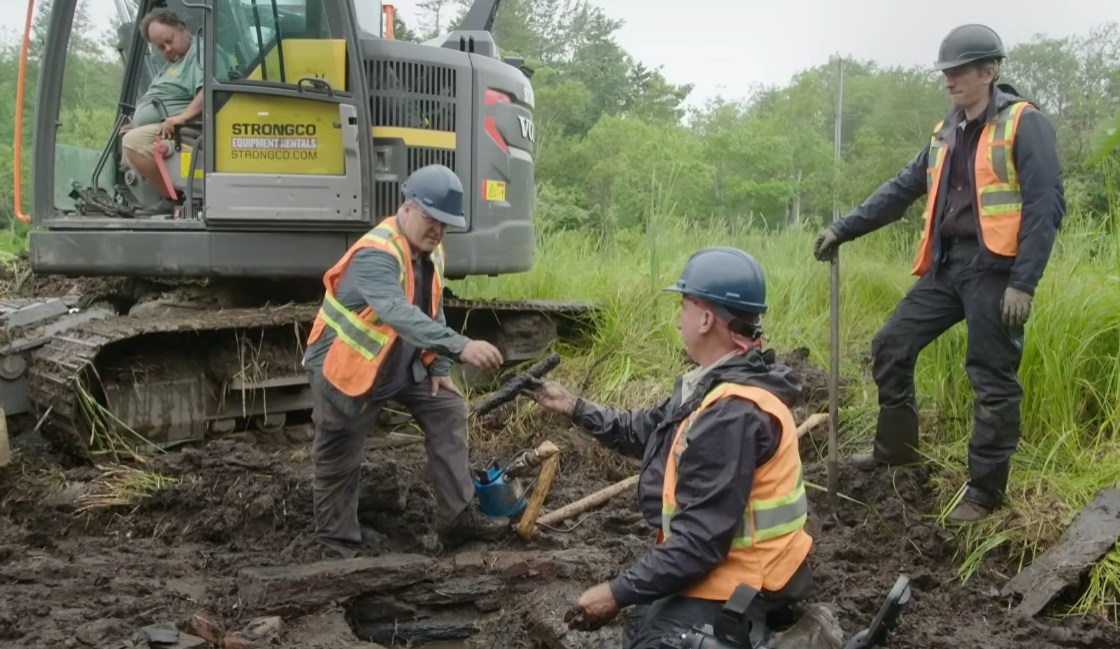
The “triangle-shaped” swamp of Oak Island is no longer being treated as a natural feature by the Lagina brothers and their team. Following a week of intensive excavation in the northern region of the marsh, investigators have unearthed a pair of engineered structures that may finally link the swamp to the 230-year-old Money Pit mystery.
The discovery of a perfectly cut slate “vault” and a 16th-century survey stake has provided the most compelling evidence to date for the theory that Oak Island was once two separate islands, artificially joined by a massive ancient construction project.
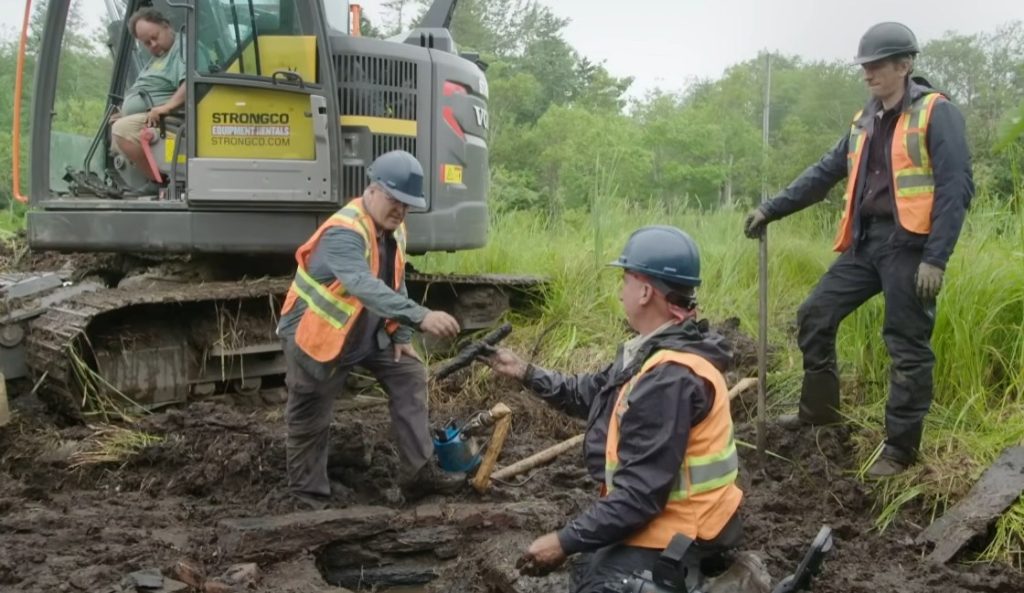
The “Safety Deposit Box” of Anthony Graves? Working on property formerly owned by Fred Nolan, the team uncovered a submerged, square stone structure built with “tightly distributed” rock sizes—a clear indicator of human engineering. While initially thought to be a well belonging to 19th-century farmer Anthony Graves, the metallurgy of recovered artifacts suggests a much older story.
Metal detectorist Gary Drayton and archeologist Laird Niven recovered three distinct items from the feature: a wrought-iron crank handle, a section of pipe, and a wrought-iron hook. “The metallurgy of the pipe and the crank handle dates them to the late 1700s,” explained archaeometallurgist Emma Culligan. “That pre-dates the recorded occupation of Anthony Graves on this lot.”
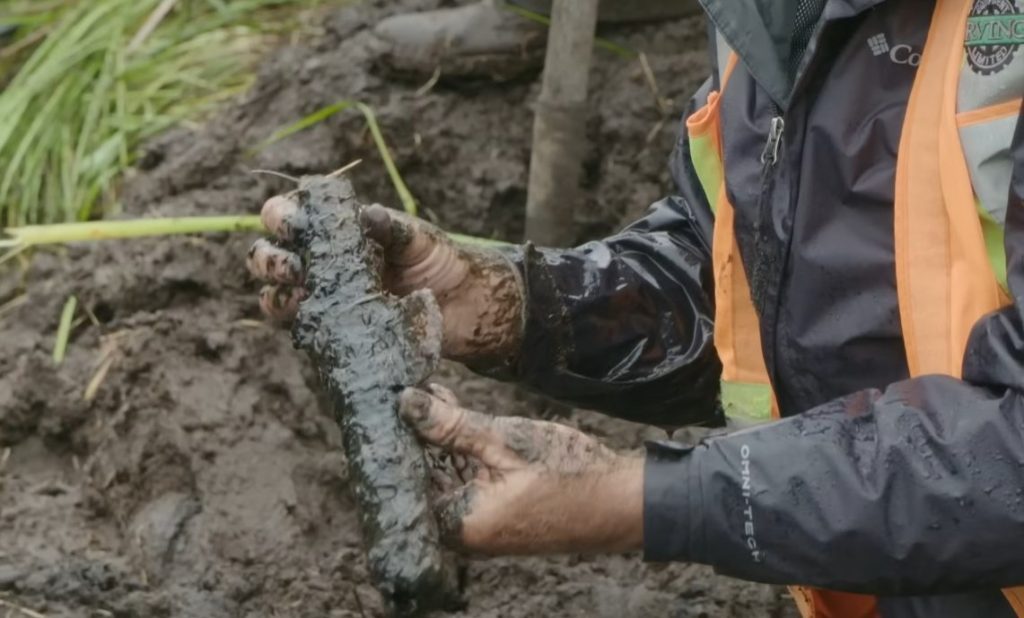
Rick Lagina theorized that while Graves may have utilized the site, he likely repurposed an existing structure to hide his rumored cache of Spanish silver coins. “I think it was his safety deposit box,” Lagina remarked. “It makes no sense other than as a structure built to contain and hide something.” Nolan’s Stake: A 16th-Century Smoking Gun Perhaps more significant than the vault was the recovery of a large wooden stake, found deep within the swamp’s silt. The artifact features four distinct axe “hacks” at its tip, matching the exact description of survey markers found by the late Fred Nolan in 1969.
Those original stakes were famously carbon-dated to 1575 (± 85 years). The discovery of a new, identical stake validates Nolan’s professional assessment as a surveyor: that the swamp was a deliberate “reclamation project” designed to hide a massive subsurface feature. “It’s not a natural shape,” Marty Lagina noted, observing the preservation of the wood that had been submerged for centuries.
“My skepticism level is diminishing.” “Aladdin’s Cave” and the Search for Ingress While the swamp yields its secrets, the team is simultaneously pushing into the “Money Pit” area via the Aladdin’s Cave cavern. Located 140 feet underground, the void was recently investigated using high-definition cameras and sonar mapping.
Imaging expert Blaine Carr revealed sonar data showing a 30-degree slope leading to a silt-covered floor. Most intriguingly, the scan identified “two gaps” in the cavern wall that Carr believes represent “potential for man-made ingress.”
The team has now authorized a second borehole to be drilled five feet away to gain a different perspective on the cavern. “We can’t walk away from this without knowing what it is,” Marty Lagina concluded. “It checks a lot of boxes for a treasure chamber.” As the team prepares for a new round of drilling, the connection between the 16th-century swamp markers and the deep underground voids of the Money Pit has never been more tangible.
 English