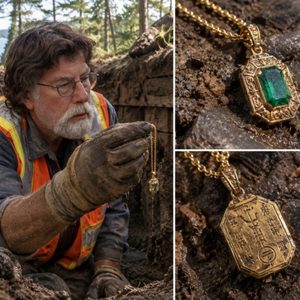
Emma Culligan is facing an unusual challenge in the Oak Island laboratory after receiving a remarkable gold ring featuring five intricately set emeralds and an unfamiliar ancient character engraved at its center.
At first glance, it appears to be an exceptionally crafted piece of jewelry.
But a closer examination reveals several details that deserve individual attention.
From the composition of the gold to the positioning of each gemstone, Emma must determine whether the ring is simply an elaborate ornament or an object carrying a much deeper historical significance.
And one particular detail may prove harder to explain than anyone expected.
EMMA BEGINS WITH THE FIVE EMERALDS
The first stage of Emma’s examination would focus on documenting the ring before attempting to interpret its mysterious inscription.
Rather than immediately concentrating on the ancient character, she would need to understand how the entire object was constructed.
The ring’s central setting features five miniature emeralds arranged around a single engraved symbol.
Their placement appears remarkably precise, with each gemstone occupying a carefully selected position.
The surrounding gold provides a frame that brings the five green stones together into one distinctive design.
For Emma, the first question would concern the emeralds themselves.
Are all five stones natural emeralds?
Do they share similar chemical characteristics?
And were they installed during the original manufacturing process?
Using magnified imaging and appropriate material analysis, she could examine their surfaces, internal characteristics, and the tiny settings holding them in place.
Even small differences between the stones might reveal whether they were selected as a matching group or assembled from separate sources.
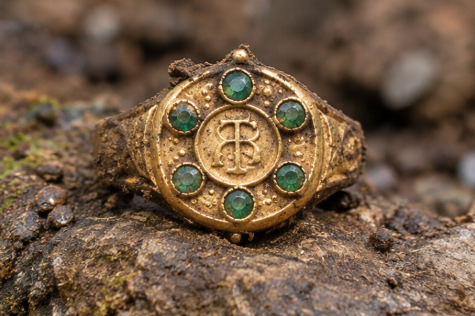
The positioning is equally important.
If the five emeralds display consistent spacing and identical setting techniques, that could support the possibility that the ring was designed as a single coordinated piece.
However, if their settings show different manufacturing characteristics, the object might have undergone repairs or alterations during its lifetime.
Emma would then turn her attention to the gold structure.
Its purity, alloy composition, and manufacturing characteristics could help establish whether the ring belongs to a particular tradition of metalworking.
But the gemstones are only part of the story.
At the center of the ring sits the feature that makes this object particularly unusual: a character that cannot immediately be identified or translated.
THE ANCIENT CHARACTER BECOMES THE BIGGEST CHALLENGE
The central inscription would become the most demanding part of Emma’s investigation.
Unlike the five emeralds, which can be examined through their physical and chemical properties, an unfamiliar character requires a different approach.
Its shape, engraving depth, proportions, and individual marks must all be documented before anyone can confidently suggest what it represents.
Emma’s laboratory has access to sophisticated equipment, including a Bruker SkyScan 1273 CT scanner, a Bruker M4 Tornado X-ray fluorescence instrument, and a D2 Phaser X-ray diffraction system.
These technologies offer different ways to investigate an artifact without relying solely on its visible appearance.
The CT scanner could be particularly useful if corrosion, dirt, or accumulated material obscured parts of the engraving.
It can produce detailed internal images without requiring the ring to be cut apart.
Meanwhile, the M4 Tornado could map the elemental composition across selected areas of the gold surface.
This would help Emma investigate whether the central engraving contains traces of a different material or whether the surrounding metal has a composition consistent with the rest of the ring.
The distinction matters.
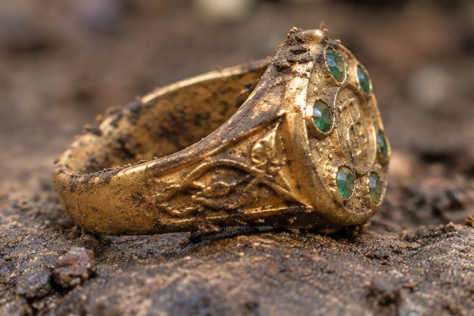
If the symbol was engraved after the ring was manufactured, microscopic tool marks might reveal a different production stage.
If it was incorporated into the original design, the relationship between the engraving and the surrounding gold could offer evidence of a unified manufacturing process.
Another question concerns the character’s shape.
Is it an individual letter, a number, a maker’s mark, or a symbol associated with a historical tradition?
Emma could document its distinctive features and compare them with established archaeological references.
However, identifying the chemical composition of an engraving is not the same as translating its meaning.
That would require specialist expertise in historical writing systems and the cultural context of the object.
There is also the possibility that the character was never intended to be read as ordinary writing.
It might represent an owner’s personal emblem, a family symbol, or a mark associated with a particular organization.
Without reliable parallels, none of these explanations could be accepted as a conclusion.
Then comes another important detail: the five emeralds.
Their arrangement around the central character could be purely decorative.
Yet if their placement follows a deliberate geometric pattern, the entire design might deserve examination as a unified composition rather than five separate gemstones surrounding an inscription.
For Emma, this is where the investigation becomes more complicated.
Understanding the ring’s materials may establish how it was made, but understanding why it was designed this way could require an entirely different kind of historical research.
COULD THE RING REVEAL SOMETHING ABOUT OAK ISLAND’S PAST?
Once the physical examination is complete, the next challenge would be determining the ring’s possible age and historical context.
Emma’s analysis could help identify the metals used in its construction, reveal differences between its components, and provide information about the techniques involved in manufacturing it.
X-ray diffraction could also assist in identifying crystalline materials present in selected samples, while elemental mapping could provide additional information about the metal composition.
However, no single laboratory result could establish the ring’s complete history.
A gold ring containing five emeralds might have been manufactured centuries ago, but its appearance alone cannot prove its age.
Even an inscription resembling an ancient character would need to be compared with reliable historical examples before any cultural connection could be proposed.
Its archaeological context would be equally important.
If an object were recovered from a documented, undisturbed archaeological layer, that information could help establish when it entered the ground.
If it came from disturbed soil, its original deposition date would be much harder to determine.
For the Oak Island team, the distinction could be significant.
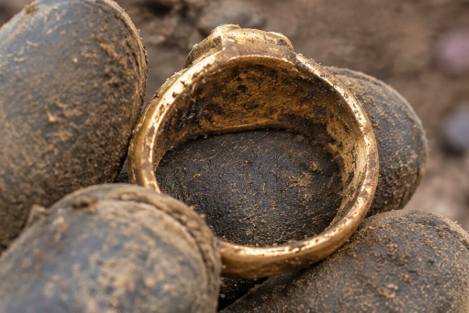
A scientifically dated object with a credible archaeological context might contribute to discussions about earlier human activity on the island.
It could potentially provide information about trade, personal possessions, craftsmanship, or the people who visited the area.
But the ring would not automatically prove the existence of a hidden treasure or establish a connection to any particular historical group.
There is one final question that could become the most fascinating part of Emma’s investigation.
Why were exactly five emeralds selected to surround that particular character?
Were the gemstones simply chosen for their beauty and value, or was their arrangement intended to emphasize a symbol whose meaning has been lost?
If the character could eventually be identified, historians might gain an important starting point for tracing the ring’s possible origins.
If the five emeralds also reveal a distinctive manufacturing tradition, the combination of evidence could narrow the possibilities even further.
For now, the gold, gemstones, and mysterious inscription would each need to tell their own part of the story.
Emma Culligan’s greatest challenge would not simply be determining what the ring is made of.
It would be discovering whether its five emeralds and unidentified character were created to serve a purpose that modern investigators have yet to understand.
And if the central symbol finally reveals its meaning, could it lead to an entirely new historical connection worth investigating on Oak Island?