The Curse of Oak Island team has uncovered another intriguing artifact at Lot 5, adding fresh evidence of activity on the island that may date back hundreds of years.
Attention has increasingly shifted toward the mysterious site, where archaeologists have been examining a rounded stone structure that has already produced a series of unusual finds.

Among the discoveries are trade beads believed to date to the 17th century, iron tools, lead objects and several old buttons.
Researchers have also identified material associated with the Lot 5 feature that has similarities to samples recovered from deep beneath the Money Pit area, raising questions about whether the two locations could somehow be connected.
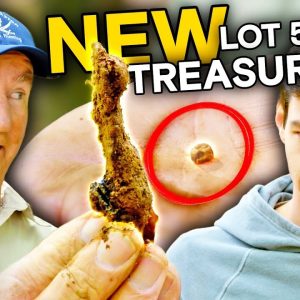
The latest breakthrough came as metal-detecting expert Gary Drayton and Jack Begley searched material removed from around the stone structure.
After detecting a non-ferrous signal, the team carefully excavated the target and uncovered what appeared to be another old button.
The copper-alloy object immediately stood out because of its unusual design and large loop on the reverse.
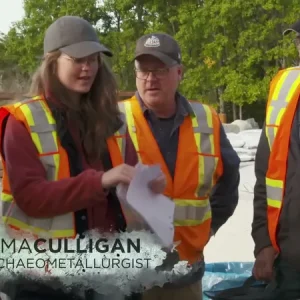
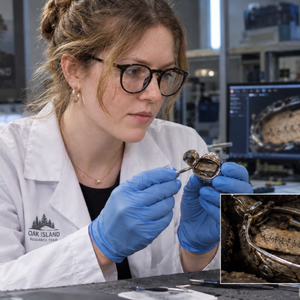
It was later taken to the Oak Island laboratory, where archaeometallurgist Emma Culligan used X-ray fluorescence mapping to reveal details hidden beneath heavy corrosion.
The analysis exposed an intricate floral pattern across the face of the button.

Its precise age has not yet been definitively established, but members of the team suggested it could date from the 1700s, while Drayton raised the possibility that it may be even older and potentially from the late 1600s.
If confirmed, that would place the object well before the traditional discovery of the Money Pit in 1795.
The button also joins a growing collection of unusual finds recovered from Lot 5.
Previous discoveries include a scalloped metal disc, a button featuring a starburst design and a heavily pitted lead ball that laboratory analysis found was made from pure lead without the modern alloying elements expected in a more recent object.
Taken together, the finds suggest that people were active around Lot 5 long before the modern treasure hunt began.
However, the discoveries have yet to establish exactly what those people were doing there.
One theory considered by the team involves Sir William Phips, the 17th-century English colonial figure known for his involvement in the recovery of treasure from the Spanish wreck Nuestra Señora de la Concepción.
Some Oak Island theories have suggested that treasure connected to Phips’ salvage operations could later have been brought to the island.
The newly discovered button does not prove any connection to Phips, but its possible age has encouraged the team to continue examining that period of history.
The larger mystery remains the purpose of the stone structure itself.

Archaeologists are continuing to excavate the site carefully because Lot 5 has been given special archaeological status by the government of Nova Scotia.
That means every artifact must be documented in its original context rather than simply removed from the ground.
This context could prove crucial.
While an old button may establish that someone was present at Lot 5, researchers still need stronger evidence to determine who built the structure, when it was constructed and what it was used for.
The variety of finds may also indicate that the site was used during more than one period.
For Rick Lagina and the Oak Island team, the importance of Lot 5 is therefore less about one individual artifact and more about the pattern beginning to emerge.
Trade beads, tools, lead objects and decorative buttons all point toward significant historical activity.
But whether that activity was connected to treasure, trade, settlement or something else remains unresolved.
The excavation is continuing, with the team hoping that another discovery could eventually establish a clearer link between Lot 5 and the wider Oak Island mystery.
For now, the ornate button provides another tantalising clue — but not yet the answer the treasure hunters have spent years searching for.