The Same Strange Symbol Seen On Oak Island Has Now Appeared Again Across Ancient Templar-Associated Sites In Italy.
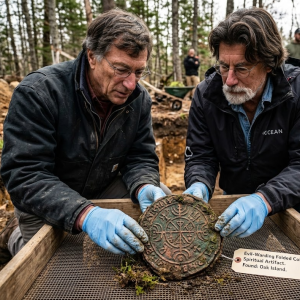
For decades, one of Oak Island’s most intriguing clues has not been a gold coin, a jewel or a hidden chamber.It is a symbol.A cross surrounded by four dots.That marking appears on the fragment known as the H+O Stone, recovered from a larger carved boulder discovered on the northern shore of Oak Island in the early 20th century.For years, the symbol remained difficult to interpret.
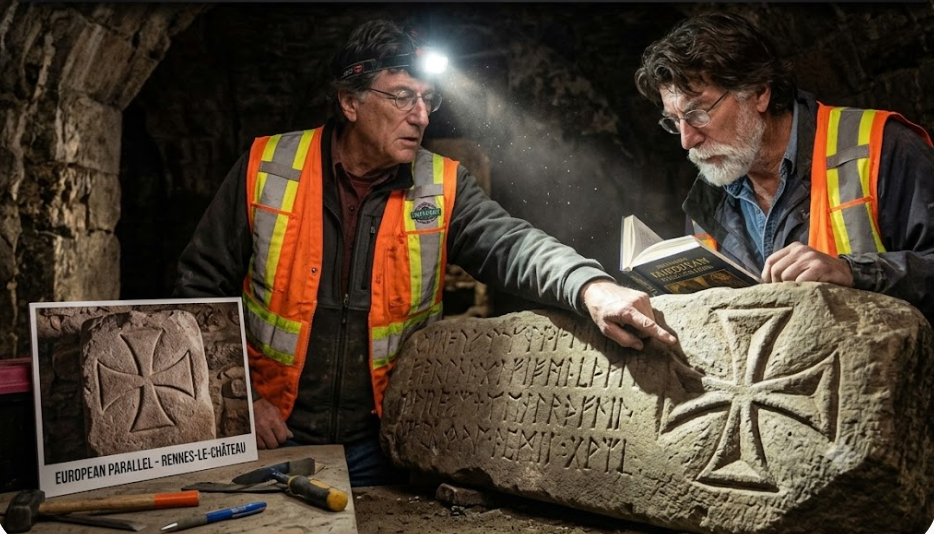
Now, Rick Lagina and his team may have found a much wider historical context.During a research trip through Italy, the Fellowship encountered similar four-dot crosses at churches, underground complexes and locations associated with the Knights Templar and Cistercian traditions.That does not prove the Templars reached Oak Island.But it gives the H+O Stone something it has long lacked:A possible cultural framework.
Viterbo Changes the Conversation
The investigation begins in Viterbo, a historic Italian city with deep connections to medieval Christianity.There, the team meets Templar researcher Gianluca Diprospero and visits Santa Maria Nuova, a church built in 1080.Inside, Peter Fornetti notices something immediately familiar.A cross with four surrounding dots.The resemblance to the H+O Stone is difficult to miss.
According to the interpretation presented during the visit, the symbol may have been used to mark special places associated with Templar activity or important religious objects.That possibility immediately elevates the Oak Island carving.If the same symbol appears repeatedly at locations with known Templar connections, then the H+O Stone may be more than a random decorative mark.It could belong to a symbolic system.
Alex Lagina Sees a Possible Message
The theory becomes even more interesting when Alex Lagina begins looking at the H+O Stone not as one isolated carving, but as a combination of symbols.He suggests that elements seen in the church could potentially be read together.The cross and four dots may indicate something Templar-related.
Another circular symbol has sometimes been interpreted as representing gold.From there comes the provocative possibility: Could the H+O Stone mean something like “Templar gold here”?It is an exciting interpretation.But it is still an interpretation.
There is no surviving medieval document confirming that exact translation.For an Oak Island analyst, that distinction matters.
The value of the discovery is not that the code has been solved.It is that the symbols now have possible European parallels worth investigating further.
The Lead Cross Adds Another Layer
The team’s Italian research does not stop with the H+O Stone.They travel to Cammarano, where an enormous network of man-made underground passages dates back more than 2,500 years.Parts of the system were later modified during the medieval period.One section immediately attracts attention because of its shape.
The chamber resembles the lead cross discovered at Smith’s Cove on Oak Island in 2017.More specifically, the proportions appear unusual in a similar way.One arm is longer than the other.Rick becomes visibly emotional because the connection brings him back to research first introduced by his late friend Zena Halpern.
For Rick, this is exactly why European expeditions matter.Artifacts on Oak Island can show that something old was present.European sites may help explain what those objects meant.
The Same Symbol Appears Again in Osimo
Then the four-dot cross appears again.At the Grotte Simonetti cave system in Osimo, the team finds carvings they believe resemble symbols associated with the H+O Stone.Rick describes this as possible “connective tissue” between European Templar traditions and Oak Island.That phrase may be the best way to understand the current evidence.Not proof. Connective tissue.A repeated symbol.A similar artifact shape.Comparable religious imagery.Possible historical overlap.Any one of those clues is weak on its own.Several together create a pattern worth studying.
Morimondo Abbey Strengthens the Pattern
The trip becomes even more compelling at Morimondo Abbey. Established by Cistercian monks in the 12th century, the monastery has a historical connection to the religious world in which the Templars operated.Outside the abbey, the team spots more four-dot crosses.
Inside, another appears near a scriptorium where monks once copied and preserved manuscripts.That location matters symbolically.
A scriptorium was not simply a room.It was a place where knowledge survived. Religious texts.Maps. Accounts.Observations. Historical records.Rick begins wondering whether information about distant voyages or important activities could have been recorded through networks connecting Templars and Cistercian monks. Again, the theory remains speculative.
But it opens a fascinating possibility.If knowledge of the New World existed earlier than conventional history suggests, monastic institutions would have been among the most capable organizations of preserving it.
The Tree of Life Creates Another Parallel
Inside the abbey, the team also notices a depiction that resembles the Tree of Life.That symbol has appeared in other locations connected with their Templar research.It also reminds them of theories surrounding Nolan’s Cross on Oak Island.
Could Nolan’s Cross itself represent a sacred geometric design rather than simply a navigational or survey feature?That question remains unresolved.But the recurrence of religious symbolism keeps pushing the Oak Island mystery in the same direction. Perhaps some of the island’s features were not designed only to hide treasure.Perhaps they were meant to encode meaning.

What the Team Still Needs
For all the excitement, the central problem remains unchanged.Symbols are difficult evidence.A cross can appear in multiple cultures.Dots can carry different meanings.Geometric designs may be religious, practical or accidental.To move the Templar theory forward, the team needs something much stronger.
A datable European artifact recovered in secure archaeological context.An inscription naming a person or order.A document describing a voyage.A symbol paired with text that clearly explains its meaning.Or physical evidence on Oak Island that can be directly linked to a known medieval European source.Without that, the theory remains compelling but incomplete.
Why This European Research Still Matters
Even so, these discoveries are important for one reason.They give the Oak Island symbols context.For years, the H+O Stone was an isolated curiosity. Now similar markings appear across multiple European locations associated with medieval religious orders.The lead cross also finds possible architectural parallels.And several recurring symbols begin to form what Rick calls an ongoing story.
That may be the real value of the Italy investigation.The team is no longer asking only:“What was buried on Oak Island?”
They are asking:“What symbolic language did the people responsible use?”And if the same symbolic language truly connects Oak Island with medieval Europe, the mystery may eventually shift from a treasure hunt into something much larger.
A story about knowledge.Religion.Voyages.And perhaps a message deliberately left behind for someone centuries later to understand.