Something is lurking in the skies above the Uintah Basin, and it does not want to be mapped. When a high-tech swarm of one hundred drones took flight over the infamous Triangle, the team expected data—instead, they witnessed a terrifying mid-air execution that sent debris raining down on their heads.

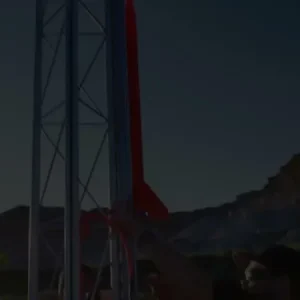
The drone swarm glowing red in the pitch-black sky above the Triangle
The High-Altitude Intrusion
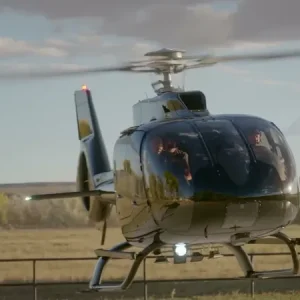
The air at Skinwalker Ranch has always felt thick with unseen static, but nothing could prepare the team for the sheer audacity of their latest endeavor. Gathering in the dimly lit command center, minds like Travis Taylor and Erik Bard met with flight specialists from Sky Elements to launch an unprecedented aerial assault on the Triangle—a localized zone infamous for bending physics and shattering digital equipment. In previous trials, minor drone swarms had experienced catastrophic telemetry failures at just under a thousand feet, suggesting a dome-like barrier of electromagnetic hostility. This time, the stakes were pushed to the absolute limit: a grid of one hundred light-emitting drones programmed to climb to a record-breaking four thousand feet, accompanied by a camera-rigged FPV craft piloted by Brian Woodward. As the countdown echoed through the freezing darkness of the East Field, the drones ascended in a perfect, glowing matrix, illuminating the Utah sky like an artificial constellation. But as the altitude readings ticked past two thousand feet, the atmosphere turned toxic. The telemetry screens in the mobile command unit began to flicker violently, and the FPV feed warped as if passing through an invisible gravitational lens, hinting at a massive, hidden intelligence preparing to strike back against this technological intrusion.

The investigation team scrambling for safety inside a mobile command vehicle
Rain of Metal and Telemetry Failure
What followed was absolute, adrenaline-fueled chaos on the desert floor. At precisely three thousand feet, the entire swarm began to shudder as if struck by an invisible fist, before suddenly plunging into darkness. One by one, the drone connections severed, their lights extinguished, and the massive matrix collapsed into a terrifying freefall directly toward the launch pad. Shouts of panic erupted over the radio as the team scrambled for cover, diving under metal awnings and ducking into vehicles while heavy drone chassis smashed into the dirt around them with sickening thuds. Refusing to let the mystery defeat them, the researchers quickly recalibrated, launching a localized group of four hardened drones to probe the exact coordinates of the failure. Like clockwork, the moment this scout fleet breached the three-thousand-foot threshold, they met the same invisible wall, their telemetry dropping to zero at precisely three thousand two hundred and seventy-one feet. This was no software bug or battery failure; it was a localized, highly targeted electromagnetic shutdown that seemed to actively defend the airspace. The data recovered from the salvage showed that the drones didn’t just fail—they were actively disarmed, their internal flight systems force-closed by an external force that refused to let them scan what lay hidden above the ancient mesa.

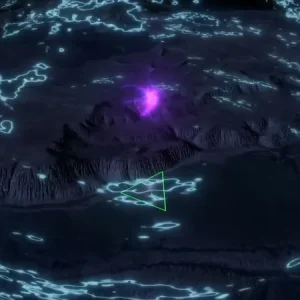
The command center monitor displaying an enhanced, high-contrast visual of a mysterious glowing anomaly next to the drones
The One-Frame Intercept
The true horror of the night, however, did not reveal itself until two days later when the team gathered in the sanctuary of the command center to analyze the high-speed optical data. Reviewing the time-lapse footage frame by frame, Erik Bard isolated the exact millisecond the second flight of drones lost power. There, hanging in the blackness just feet from the falling quadcopters, was a brilliant, saucer-like flash of light that appeared for only a single frame before vanishing into the ether. When the imaging software enhanced the high-contrast data, the anomaly resolved into a dual-ringed, glowing object with a distinct propulsion trail—a highly structured UAP caught in the act of neutralizing the team’s equipment. It became chillingly clear that the drones had not merely run into a bad signal; they had been intercepted. The implications of this discovery are staggering, suggesting that whatever dwells within the airspace of Skinwalker Ranch is not a passive energy field, but an active, intelligent sentinel capable of deploying localized electromagnetic pulses to shield its presence from humanity. The team sat in stunned silence as the realization settled in: they are not just conducting science on an anomalous ranch, they are actively engaging with an elusive, defensive technology that remains steps ahead of our most advanced instruments.

A close-up analysis of a bizarre dual-light phenomenon captured in the night sky