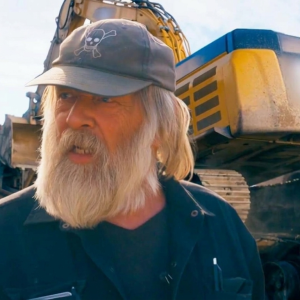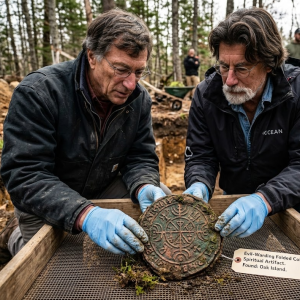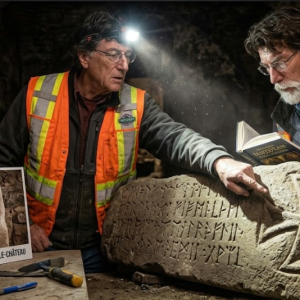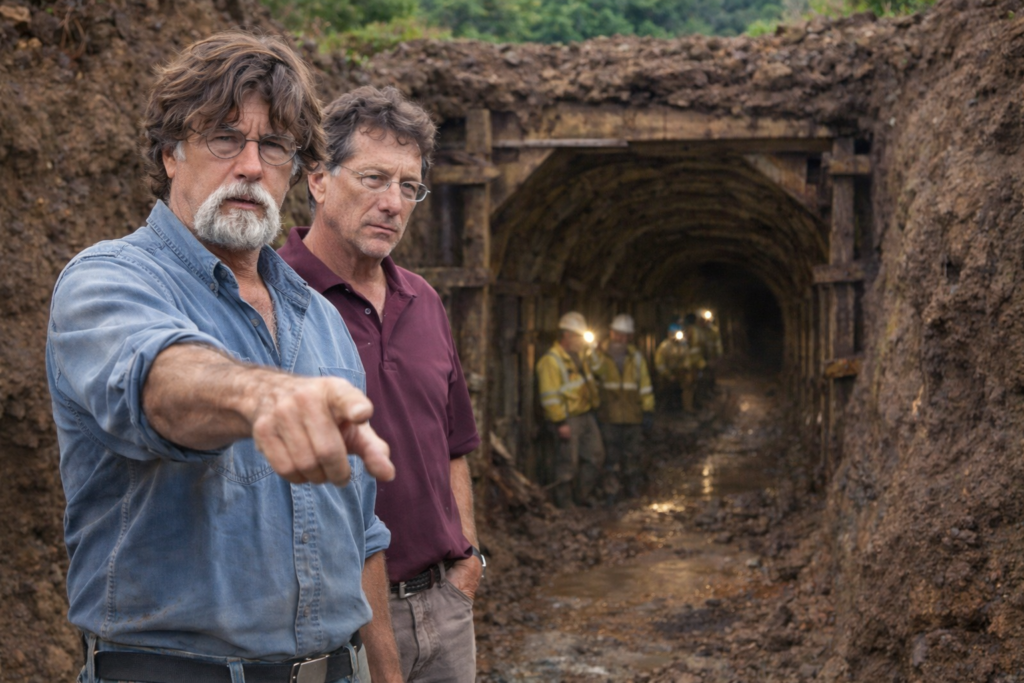
The Oak Island team may have reached one of the most important moments in its long search after exposing a believed tunnel beneath the Garden Shaft, a structure that could be connected to the Money Pit mystery and the precious metals detected nearby.
Rick and Marty Lagina, along with members of the Oak Island team and representatives from Dumas Contracting Limited, have been working to extend the Garden Shaft deeper into the ground. Their target was a possible seven-foot-high tunnel believed to run toward the area known as the Baby Blob, where earlier testing indicated traces of precious metals.
After weeks of careful excavation, the team reached a depth of roughly 95 feet. At that level, workers reported seeing wood, giving the search team hope that they had finally reached the tunnel identified during previous sonic drilling work. For Rick Lagina, the moment carried enormous significance. After years of theories, setbacks and technical challenges, the team could now physically inspect a structure that had previously existed only as scan data and drilling evidence.
Before the tunnel was exposed, Rick and Marty joined workers inside the Garden Shaft to help remove hard clay near the bottom. Wearing protective gear, the brothers used pneumatic jackhammers to loosen the compacted material before a hammer grab could remove it from the shaft. The work was physically demanding, but both brothers appeared eager to take part.
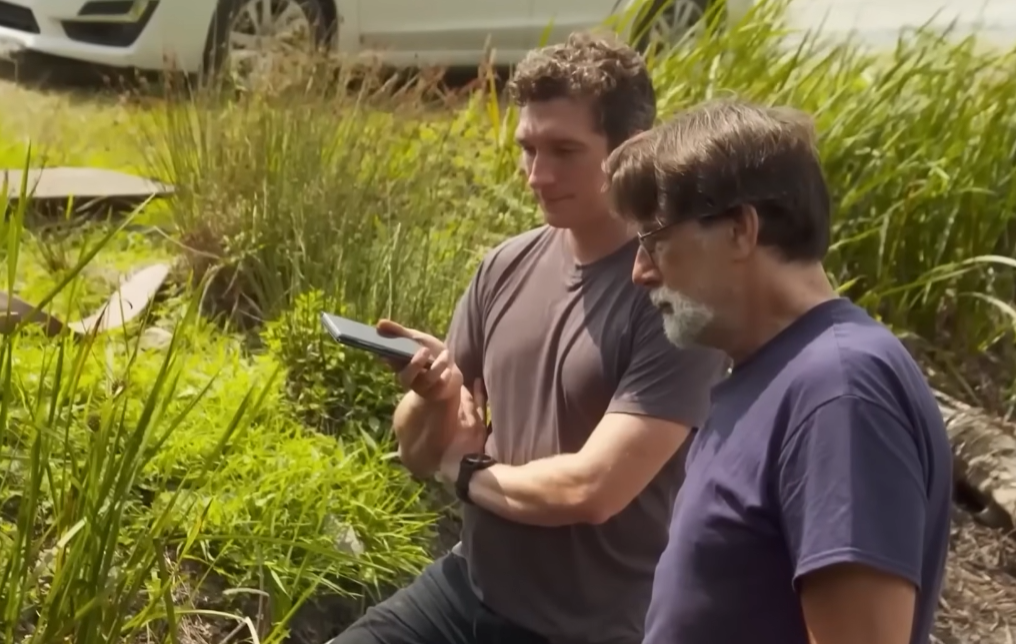
For Rick, the task was personal. He described being focused entirely on getting the clay out of the hole and reaching what might be an original tunnel. Marty also reflected on the family connection to mining, noting that their grandfather had come to North America to work in the mines of Michigan. For the Lagina brothers, the descent into the Garden Shaft was not only part of the treasure hunt, but also a connection to their own heritage.
The breakthrough came later when Dumas representatives confirmed that the team had hit its target. Wood was visible at the bottom of the shaft, and the team quickly prepared to inspect it. Rick, Scott Barlow and Craig Tester entered the area to examine the structure, where they found round timber and indications of hollow space beneath the wood
That detail immediately drew attention. According to the traditional Money Pit story, early searchers reported layers of logs at intervals underground. The presence of round timbers in the Garden Shaft area therefore created a possible link to the original works. Scott Barlow suggested that round logs were more encouraging than square timbers, which might have pointed more clearly to modern searcher activity.
The team had already received carbon dating results from wood samples taken earlier by core drilling, with some material reportedly dating to the 17th century. Now, with more of the structure exposed, they planned to remove larger beams for additional testing. If the dates are confirmed, the tunnel could predate the commonly accepted discovery of the Money Pit in 1795.
As more of the tunnel was uncovered, Rick described the evidence as real and physical, rather than an interpretation. Large beams were visible, some rounded and apparently shaped by hand. The team noted that one timber appeared to have been cut with an adze, a traditional woodworking tool used for shaping timber before modern mechanised methods became common.
That detail could become important in establishing the age and purpose of the structure. A hand-shaped timber does not, by itself, prove who built the tunnel or why it was constructed. But when combined with earlier carbon dating, its depth and its alignment toward the Baby Blob, it gives the team another reason to believe the Garden Shaft may be close to original underground work.
Gary Drayton was then brought into the shaft to conduct metal detection around the exposed structure. Although the surrounding iron made the search difficult, he recovered small metal objects that may have been associated with the tunnel’s construction. The artifacts were set aside for lab analysis, with hopes that they could help date the structure or reveal more about the people who built it.
Surveyor Steve Guptill also entered the tunnel area to record control points. For the first time, the team could map the exposed tunnel directly rather than relying only on drilling projections. Accurate survey data could help determine where the tunnel leads and whether it lines up with other important features in the Money Pit area.
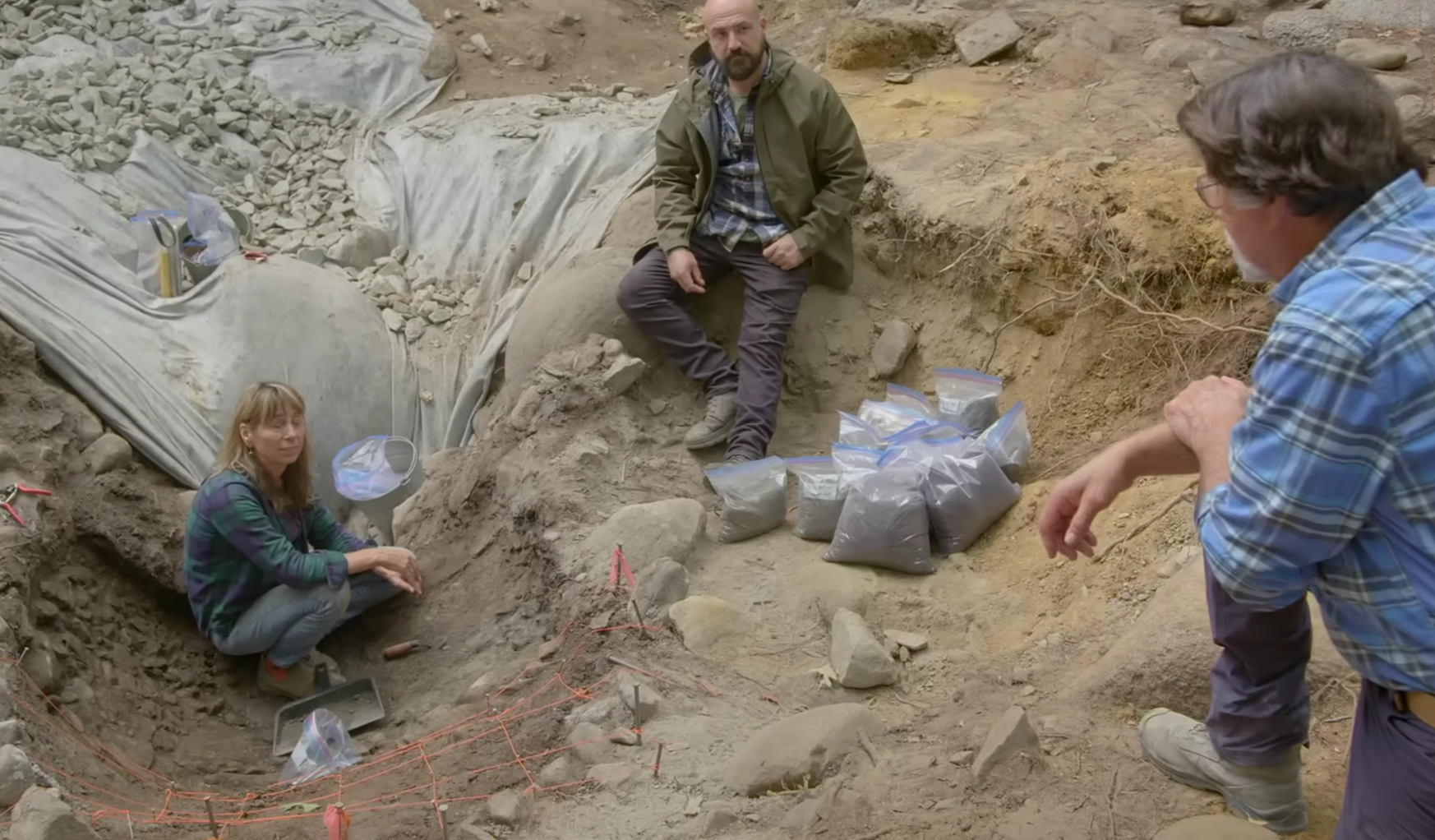
The discovery comes alongside other intriguing finds from Lot 5 and the surrounding areas. At the Oak Island Interpretive Center, Gary Drayton, Laird Niven and Emma Culligan presented analysis of a coin found in a stone foundation near the shoreline. CT scanning suggested it may be an English penny or half penny from the reign of King George III, possibly dating to the 1770s. If accurate, the coin would predate the 1795 discovery of the Money Pit.
The team also recovered fragments of pottery near the stone road area, including pieces that may be Chinese porcelain. Gary suggested that some of the material could point toward old trade routes, while Rick said the collection of pottery might help explain the purpose of the stone road and related features. A possible old shoe heel with hobnail construction was also found nearby, adding another clue to the activity that may have taken place around the swamp.
For now, however, the Garden Shaft tunnel remains the central focus. The team still needs to expose more of the structure, remove samples, conduct further testing and determine whether the tunnel is accessible. Dumas is expected to carry out additional probe drilling into the tunnel’s interior, which may help locate the source of the precious metal readings detected nearby.
The find does not yet solve the Oak Island mystery. But it may represent one of the clearest physical links between modern excavation and a possible underground structure connected to the original Money Pit story. After years of searching, the team is no longer simply chasing signals on a screen. They are standing above real timber, real construction and a possible path toward answers.
For Rick and Marty Lagina, that is why the Garden Shaft now feels so important. If the tunnel proves to be original work, it could mark a turning point in the search. And if it truly leads toward the Baby Blob, Oak Island may be closer than ever to revealing what has been hidden beneath the Money Pit for centuries.