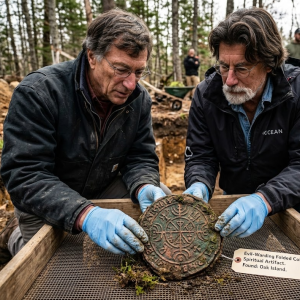
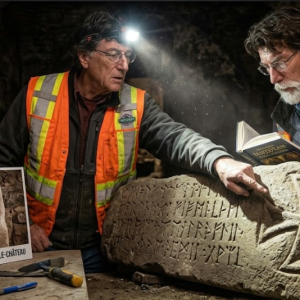
In the world of explorers and dreamers, Oak Island is more than just a piece of land; it is a mathematical enigma that has defied humanity for over two centuries.
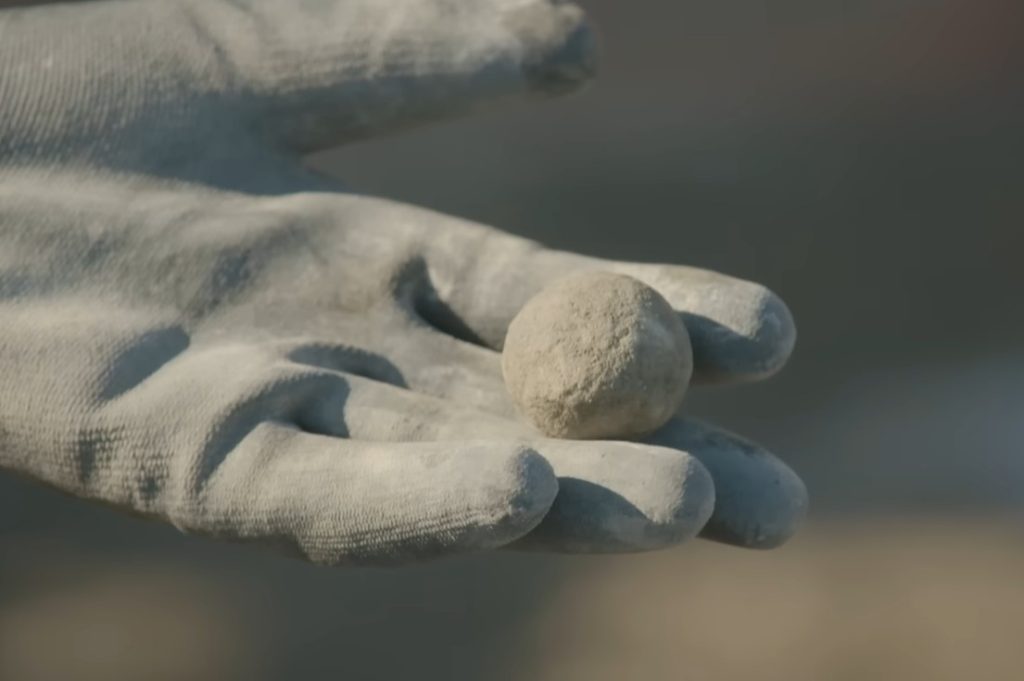
While previous chapters of this grand excavation might have exhausted audiences with endless mud pits, the latest developments at the Peacock-1 shaft feel like a pivotal turning point in a high-stakes detective thriller. New physical evidence has emerged, immediately igniting a shocking question: Have we been searching for a simple treasure, when in fact we are standing atop a forgotten European historical legacy from long before the time of Columbus?
When the Mud Speaks: “Smoking Gun” Evidence at 100 Feet
The spotlight is currently fixed on the washplant—the filtering station where the spoils from the depths of the Peacock-1 shaft are meticulously screened. Amidst the sludge and debris, a perfectly spherical artifact has surfaced, fundamentally changing the game. This is a “stone shot”—a type of ancient artillery ammunition used in medieval naval warfare and fortress defense.
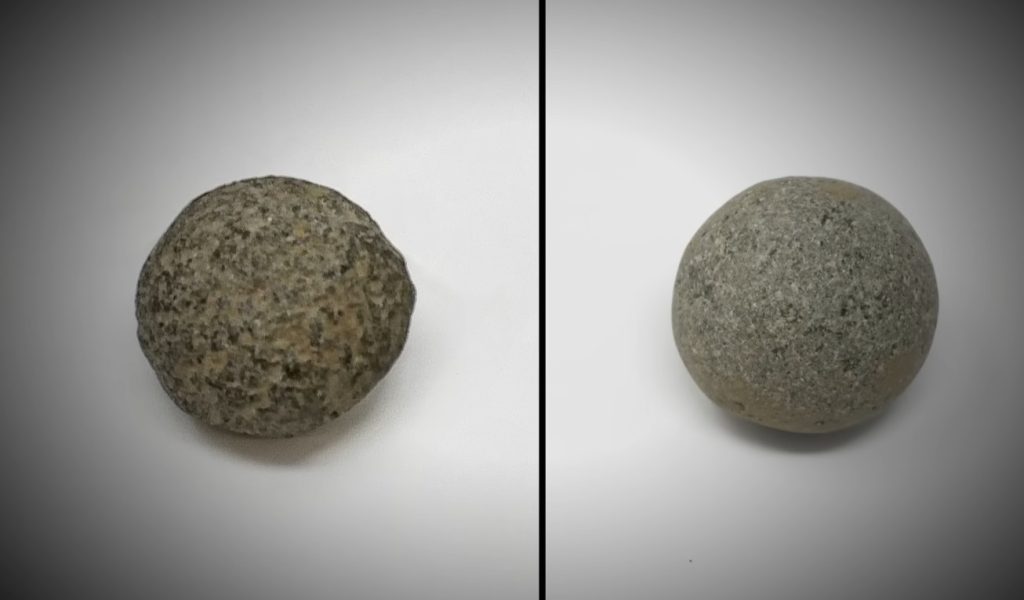
From an archaeological perspective, this is a staggering find. Stone shots are not products of nature; they do not appear tens of meters underground without human intervention. Finding this third stone shot (following previous discoveries at Lot 15 and the Money Pit) at such an unprecedented depth puts an end to any doubts of coincidence. it confirms a definitive truth: A massive construction campaign—likely military or designed to protect a secret—took place here long before three farmers discovered the mouth of the Money Pit in 1795.
Decoding the Portuguese Cipher and the Ghost of the Templars
The narrative grows even more dramatic as the artifact enters the laboratory of specialist Emma Culligan. Through modern CT scanning, “peck marks”—the tell-tale signs of a stonemason’s craftsmanship—become clearly visible, proving the object is man-made. However, the real shock lies in the historical comparison: the Oak Island stone shot matches perfectly with specimens housed in the Military Museum in Lisbon, Portugal.
This data opens a breathtaking chain of logic. The use of stone shot peaked during the 14th and 15th centuries before being replaced by cast iron around 1450. If this projectile truly belongs to 15th-century Portuguese artillery, it would serve as undeniable evidence of a European presence in North America well before Christopher Columbus’s 1492 voyage.
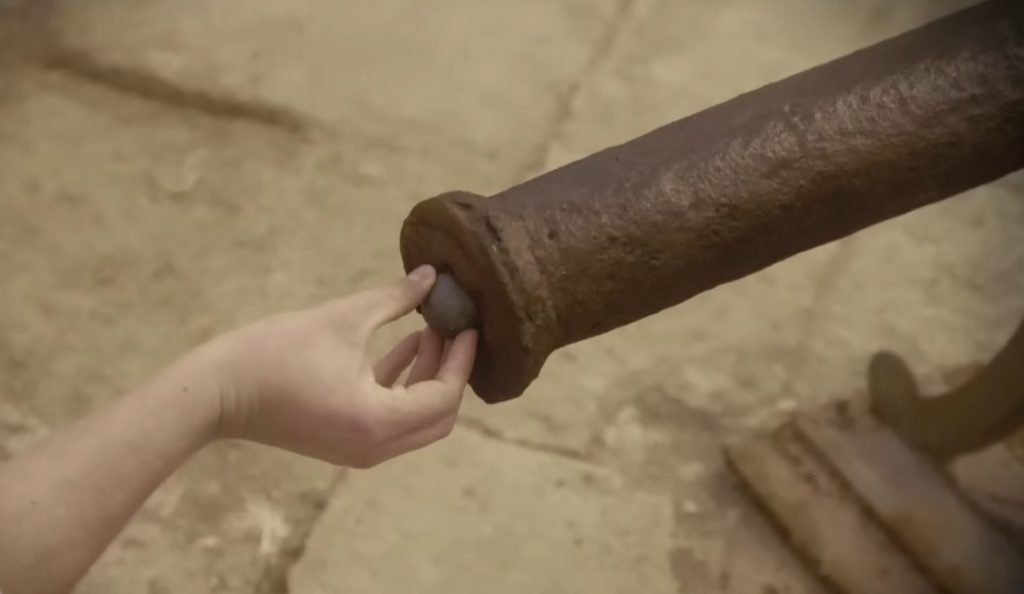
Expanding on this, hypotheses regarding the Knights Templar—who fled Europe carrying their secrets to the New World—suddenly become plausible. Perhaps the Portuguese, the master mariners of that era, were the ones who facilitated the transport or directly buried a massive heritage beneath the island’s complex hydraulic systems?
The Final Verdict: A Legend’s Turning Point
In a reflective conversation between Rick and Marty Lagina, we witness a clear shift in the mindset of the hunters. Moving away from the singular craving for glistening chests of gold—which has often led to disappointment—they are transitioning toward a more rigorous, scientific path: Archaeological Historical Validation.
Sending the stone sample to Dr. Raiside at Acadia University for geological analysis is the “final strike” to test the Portuguese hypothesis. If the analysis confirms the stone originated from the Azores archipelago, the world’s history books will have to be rewritten.
In conclusion, Oak Island is no longer a random game of chance. Artifacts like the stone shot and ancient concrete are piecing together a logical portrait of a grand underground architectural feat. My verdict? The “real” treasure of Oak Island may not be gold, but the proof of an oversea expedition that predates official history by centuries. We aren’t just waiting for a hoard; we are waiting for a historical truth to be unearthed.
Will the next drill bit strike the source of the final stone shot? The answer likely lies in the upcoming geological analysis, where science will finally take the place of curses.