For more than two centuries, Oak Island has captivated historians, adventurers, and skeptics alike. From mysterious wooden platforms to unexplained flood tunnels, the island’s layered secrets have defied every attempt at complete discovery. But new findings from the latest episodes of The Curse of Oak Island may represent the most compelling evidence yet that something extraordinary lies beneath the surface.
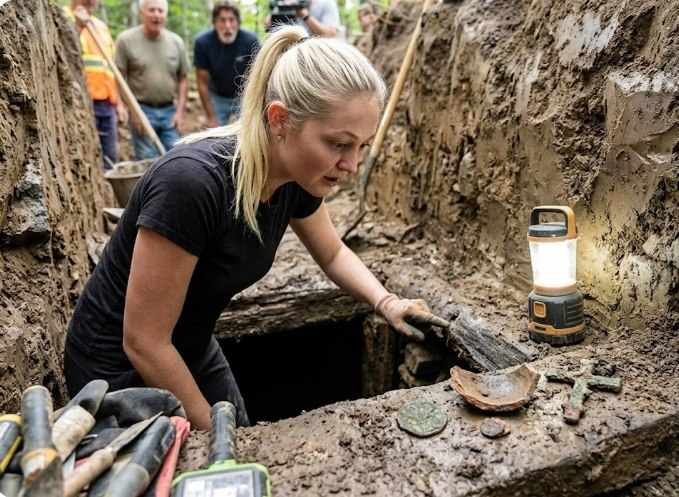
In a dramatic turn during Season 10, Episode 15, drilling at borehole DN 11.5 revealed an unexpected open void nearly 90 feet underground. The discovery came while Rick Lagina momentarily stepped away from operations, leaving Charles Barkhouse and geologist Terry Matheson to oversee drilling in the area known as the “Treasure Zone.” The drill encountered sudden resistance before breaking through into empty space — a chamber that stretched approximately a foot and a half beyond the drill rods.
The alignment of this void with earlier findings in DN 12.5 and DN 13.5 suggested an organized structure rather than a natural cavity. Core samples added to the intrigue. Wood recovered from the borehole was sent for testing, and preliminary results hinted at elevated gold traces — an anomaly not typically associated with Oak Island’s natural environment. When Emma Culligan at the interpretive center re-examined the XRF results, she confirmed the presence of gold within the wood fibers.
The combination of gold signals in both wood and surrounding water brought a new level of urgency to the investigation. Many on the team believed this could be the first physical breadcrumb leading toward a long-suspected treasure tunnel. Season 11 only intensified the mystery. In the first episode, excavations on Lot 5 revealed unexpected pottery fragments, including a piece of redware with purple glaze possibly dating back to the 1600s.
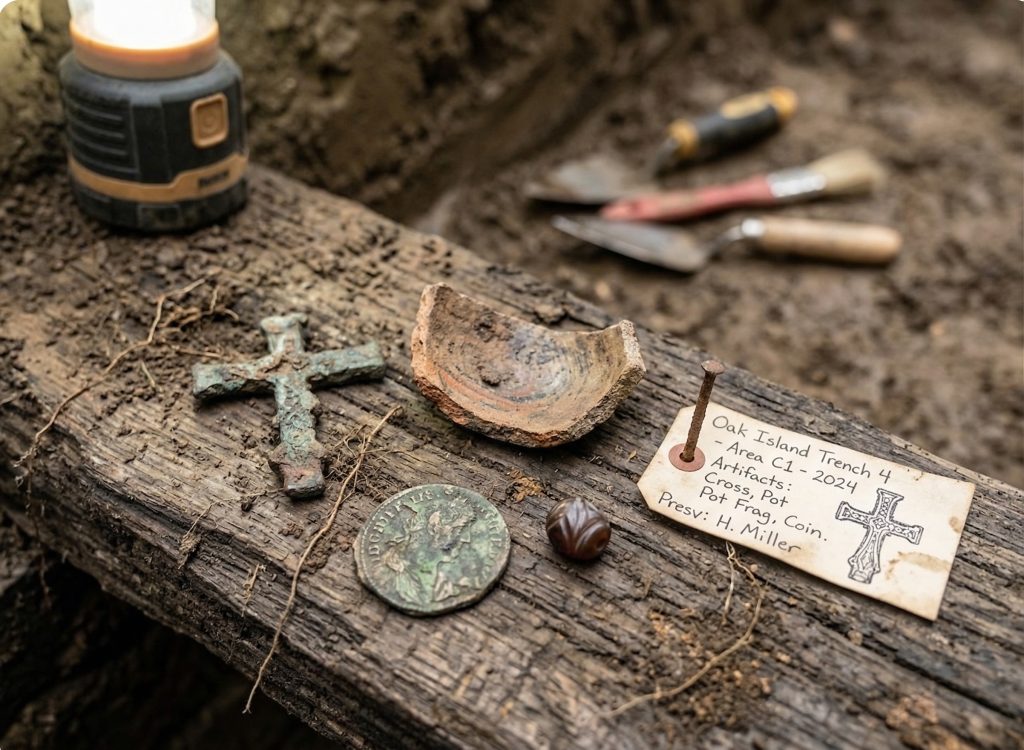
Lead archaeologist Dr. Alastair Richards noted that the pottery style was consistent with early European transport containers. More discoveries followed. A second pottery shard, thicker and older, suggested Lot 5 may have hosted settlement activity long before the Money Pit’s documented discovery in 1795.
The search quickly gained momentum when a series of ancient coins surfaced. The first resembled a hammered Roman coin, though analysis later proved it was a non-Roman copper-silver mix. A second coin held elements consistent with ancient Roman metallurgy, while a third was confirmed to be a French denier from the 13th century.
Such diverse origins raised new questions: Was Oak Island once a crossroads for European groups long before colonial settlement? Excitement grew when a fourth coin — also hand-hammered — was discovered. Soon after, a large iron relic surfaced near a circular depression on Lot 5.
Blacksmith expert Carmen Legge identified the object as part of a centuries-old pair of scissors, possibly European. The presence of French-style artifacts in particular revived theories referencing medieval maps and earlier expeditions — including potential links to the Knights Templar. But the most striking discovery in the early season came from a second structure hidden beneath Lot 5: a rectangular foundation estimated to originate in the 1700s. Archaeologist Helen Sheldon described the site as unlike anything she had encountered in her four-decade career.
The foundation’s perimeter was well-constructed with stone, yet the central area appeared intentionally disrupted, as though built around an earlier feature. Matching creamware fragments dated to 1762 reinforced the notion that secretive activity — possibly military — may have occurred on the lot long before the island’s division into formal land parcels.
Meanwhile, underground scanning at The Money Pit provided new scientific support to the treasure theory. Using muon tomography, IDON Technologies documented multiple high-density anomalies between 65 and 230 feet below surface. These anomalies, highlighted in red and orange on the imaging maps, indicated dense material consistent with metal or structural remains.
A massive low-density zone beneath the Garden Shaft correlated with borehole L15, nicknamed “Aladdin’s Cave,” where unusual artifacts had been found earlier. In Episode 6, the Garden Shaft produced yet another clue: a large iron wedge recovered from deep mud hauled up by the Dumas crew. The wedge, possibly the head of a mining axe, appeared old enough to match the era of the island’s earliest known depositors. Its discovery 80 feet underground suggested deliberate placement or usage related to tunneling.
Finally, a remarkable artifact from Lot 5 added even more historical weight: a lead bag seal bearing the markings of Jay Lloyd Parker & Co., a London-based supplier active in the 1700s. Unlike typical merchant seals, this one showed archaic lettering consistent with even earlier origins.
The discovery reignited theories that British military operations may have once taken place on the island — or that the seal could have belonged to the original treasure depositors themselves. With every new artifact — from hammer-struck coins to centuries-old iron tools — the story of Oak Island grows richer and more complex. The alignment of underground tunnels, the presence of gold traces, and the variety of European artifacts all point toward a deeper narrative that stretches across time and cultures.
As Season 11 continues, one question remains at the center of global curiosity: Are the Oak Island team finally closing in on the long-lost treasure that generations of searchers have spent their lives chasing? With new evidence emerging each week, the answer may soon be closer than ever.
 English