
Long before modern drilling rigs and sonar scans reshaped the hunt on Oak Island, one man believed he could outmatch every failed expedition before him. In 1893, determined treasure hunter Frederick Blair set his sights on the island with bold confidence, convinced his advanced drilling equipment could reach depths no one had ever touched. Driven by ambition and the promise of discovery, he founded the Oak Island Treasure Company—launching a daring quest to finally unravel the island’s most enduring mystery.

Four years later, Blair’s confidence appeared justified. While drilling an exploratory borehole near the site of the original Money Pit, his chief drill operator, William Chappell, and his crew encountered what many believe to be one of the most significant discoveries in Oak Island’s long history. As the drill cut deeper into the earth, the crew struck a cement-like material at an extraordinary depth. The substance did not resemble natural bedrock. Instead, it suggested a constructed chamber—possibly a vault—lying beneath the surface.
Acting on this belief, the crew continued drilling into what they theorised was an underground structure. What emerged next would fuel speculation for more than a century. Among the material brought up from approximately 153 feet underground was a tiny object—described by one participant as a pea-sized brown ball. Carefully unfurled with tweezers, it revealed itself to be a small fragment of parchment bearing the handwritten inscription “VI.” The writing appeared to have been done with a quill pen and Indian ink, consistent with writing methods of the era.
To many observers, the find raised a staggering question: had William Chappell uncovered a fragment of an original handwritten Shakespeare manuscript?
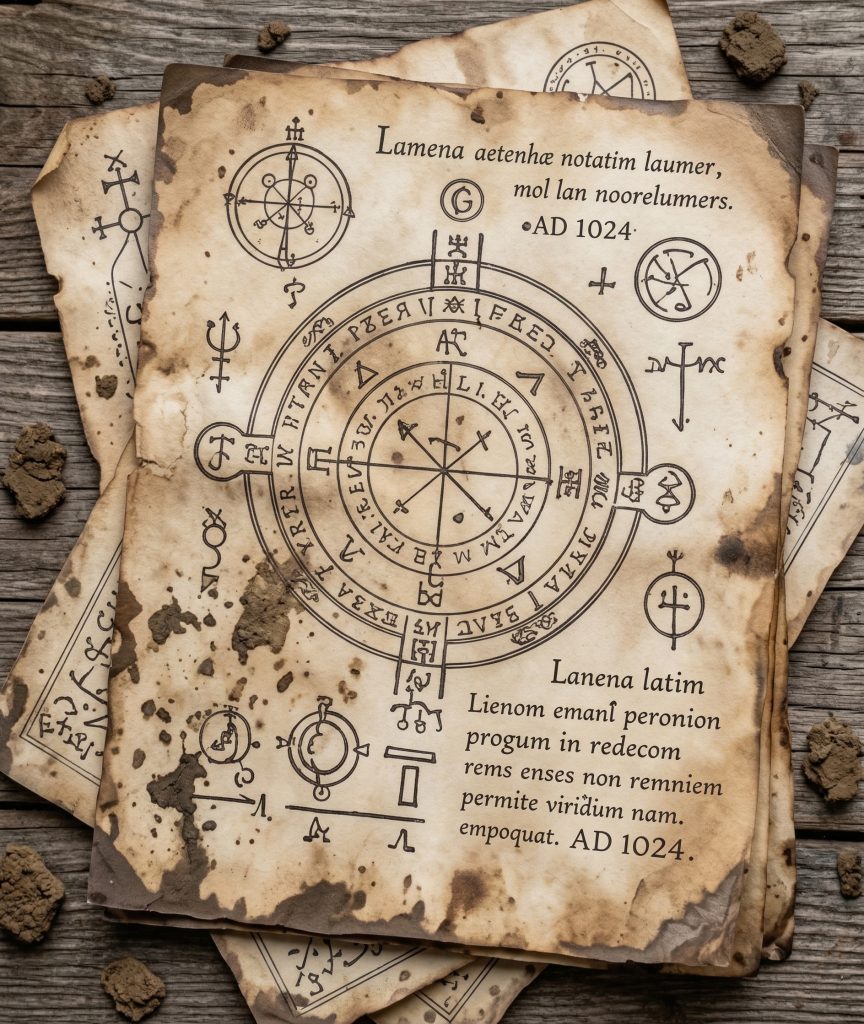
At the time, the idea seemed almost impossible. Yet the context made it difficult to dismiss outright. The parchment had reportedly come from a depth far beyond typical surface disturbances and from within what appeared to be a man-made underground structure. If genuine, it would represent not just a literary discovery, but one of the most important cultural finds in history.
Unfortunately, the mystery deepened almost as quickly as it emerged. Shortly after the discovery, the wet and porous ground surrounding the vault began to collapse. Water infiltration destabilised the structure, causing what became known as the Chappell Vault to sink deeper into the earth, effectively sealing it beyond reach.
With the technology available at the time, Blair’s team was forced to abandon further excavation, leaving the parchment fragment and its origin unresolved. For decades, the story lingered as one of Oak Island’s most tantalising “what ifs.” In 2013, the mystery took on new life when Norwegian researcher Petter Amundsen travelled to Oak Island to test a theory that blended literature, cryptography, and ancient symbolism.
Amundsen believed that clues hidden within the First Folio of Shakespeare’s works pointed directly to Oak Island as the burial site of the Bard’s original handwritten manuscripts. To Amundsen, the value of such documents rivalled any chest of jewels. “If there are documents,” he argued, “they tell us stories—ancient information, ancient knowledge.” He maintained that even the possibility of Shakespeare’s manuscripts being preserved underground was as rich and extraordinary as any treasure of gold or gems.
Central to Amundsen’s theory was a concept he called the “Mercy Point,” one of ten locations on Oak Island corresponding to symbols from the Tree of Life—an ancient mystical diagram. According to his interpretation, each point should be marked by strategically placed boulders, forming a pattern that could lead to the entrance of a hidden underground vault. The challenge was access. The Mercy Point, Amundsen believed, lay submerged beneath roughly six feet of water near the eastern edge of Oak Island’s triangular swamp.

Attempting to investigate the area, he and the team encountered dangerous conditions. Beneath the murky water, probing revealed what appeared to be a stone floor covered with small rocks—suggesting deliberate construction rather than natural terrain. However, safety concerns prevented further exploration.
With visibility low and footing uncertain, Amundsen was forced to withdraw. Yet he left the island convinced his theory was sound. “I like to decipher things,” he said, maintaining that the codes embedded in Shakespeare’s works pointed to Oak Island with remarkable consistency. If his interpretation was correct, he believed the Mercy Point could serve as a doorway to something extraordinary.
Scepticism remains, even among those closely involved in the search. Some acknowledge the theory’s ambition while cautioning against drawing firm conclusions. Yet few dismiss it entirely. Oak Island has repeatedly produced evidence that challenges conventional explanations, from unexplained structures to artefacts found at remarkable depths. As one observer noted, if something lies hidden beneath the swamp, it could be beyond belief—ranging from ancient religious relics to secret documents linked to esoteric societies, or even Shakespeare’s long-lost manuscripts.
More than a century after Frederick Blair’s drill first struck something unexpected beneath Oak Island, the questions remain unresolved. The parchment fragment, the sunken vault, and the theories layered atop them continue to blur the line between history and legend. For those drawn to Oak Island, that uncertainty is not a flaw—it is the reason the mystery endures.
 English