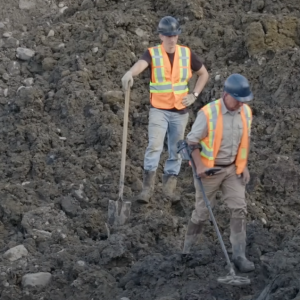
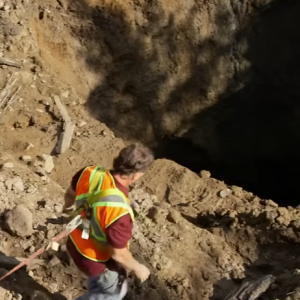
Ancient ring at the Money Pit: a small object may have opened a dangerous new path toward the treasure long believed to be concealed beneath Oak Island.
With the potential prize estimated at $42 million, the ring is being framed as more than an isolated artifact.
If its age, location, and connection to the site can be established, it could become a crucial sign that the Money Pit was shaped by purposeful activity.
Yet the discovery also creates a more unsettling question: does the ring point toward the treasure itself, or toward another layer of the island’s elaborate deception?
A Small Ring Disturbs the Money Pit’s Silence

The ancient ring carries weight far beyond its size because of where it was discovered.
At the Money Pit, context can turn an ordinary object into a challenge to everything believed about the island.
Every potentially old artifact raises the possibility that someone reached this ground long before the modern search began.
A ring, however, feels unusually personal.
It suggests a human presence, a lost possession, and a moment that may have unfolded near the very center of Oak Island’s greatest mystery.
That does not automatically make the object proof of treasure.
Its age, material, and precise historical connection have not been confirmed in the limited details surrounding the discovery.
Without those answers, the ring cannot yet establish who owned it or why it ended up at the Money Pit.
It could reflect activity unrelated to any deposit, or it could have moved through disturbed soil over centuries of excavation.
Those uncertainties matter because Oak Island has repeatedly blurred the boundary between original evidence and the wreckage left by generations of searchers.
Still, the location keeps the possibility alive.
If the ring belongs to an early period of activity and remained connected to an undisturbed layer, its discovery could indicate that people were present at the Money Pit for reasons never fully explained.
That would transform it from a curious relic into a marker within a much larger hidden story.
The ring would not need to reveal the treasure on its own.
It would only need to prove that someone came there, carried something significant, and left behind a trace that survived.
The $42 Million Theory Moves Closer to the Edge

The estimated $42 million treasure gives the discovery explosive consequences, but that figure remains part of the mystery rather than a confirmed recovered value.
No chest or cache has been established by the ring alone.
What the object may offer is direction: a way to reconsider whether the Money Pit contains evidence of intentional concealment instead of only a maze created by natural conditions and later excavation.
If the ring can be connected to a specific era or group, it could narrow the historical possibilities around the site.
That connection might support one theory while placing others under severe pressure.
The identity of the original depositors, their route onto the island, and the purpose of the Money Pit have always depended on fragments that can be interpreted in competing ways.
A securely dated personal object could become a rare anchor, tying human activity to a particular point in time and forcing the entire treasure narrative to shift around it.
But the gap between a promising clue and a $42 million conclusion is enormous.
The ring does not explain what was hidden, how deep it lies, or whether anything remains after centuries of disruption.
It also cannot show, without further confirmation, that its owner participated in constructing or using the Money Pit.
That uncertainty intensifies the drama.
Oak Island may have offered a real historical signal, yet the signal is still too faint to reveal whether it leads to wealth, an abandoned operation, or a truth more valuable than the rumored prize.
One Clue Could Validate Years of Belief or Break Them

The next consequence is not simply another search for metal or stone.
The ring creates a test.
Its significance depends on whether investigators can place it within the Money Pit’s original story rather than the island’s later history.
If that connection holds, the discovery could justify a tighter focus on the surrounding area and on any underground pattern associated with the same period.
The smallest verified detail could expose a path that earlier searches missed.
That path would also increase the pressure.
The Money Pit has been altered by repeated digging, drilling, flooding, and attempts to reach uncertain targets below.
Every new interpretation competes with the physical instability of a site that no longer preserves its history neatly.
A clue may point toward the right ground while previous excavation has shifted, damaged, or buried the evidence needed to confirm it.
The closer the search appears to move, the greater the risk that the island’s disturbed layers will conceal the answer again.
The ancient ring therefore stands at the center of two opposing outcomes.
It could become a meaningful link between early human activity and the rumored treasure estimated at $42 million.
Or it could reveal how easily hope can gather around an object whose full story remains unknown.
Either result would matter.
Confirmation could push the Money Pit toward its most important breakthrough, while failure could weaken a theory that has survived for generations.
For now, Oak Island is holding the crucial part of the answer beneath the surface.
The ring has not ended the mystery.
It has made the mystery harder to ignore, and it has brought the search closer to a moment that could either validate years of belief or tear the treasure story open.