For years, Nolan’s Cross has remained one of the most intriguing features on Oak Island.
Its unusual arrangement has inspired countless theories, but a new comparison highlighted in Season 14 is bringing an old historical possibility back into focus.
Researchers have examined the formation alongside a geometric pattern reportedly found on the wall of a Templar church in France.
The comparison has produced something particularly interesting: eight potential locations for further investigation.
But why does this connection matter, and could the geometry hold a clue to who originally laid out Nolan’s Cross?
THE PATTERN THAT REFUSES TO BE IGNORED
Nolan’s Cross has long occupied a special place in the Oak Island mystery.
Unlike an ordinary collection of stones scattered across the landscape, its distinctive arrangement has encouraged researchers to consider whether the formation was deliberately constructed according to a particular design.
The structure consists of several large boulders positioned in a cross-like configuration.
Their placement, proportions and relationship to one another have become the foundation for numerous interpretations.
Some researchers have explored whether the formation could represent a navigational marker, a symbolic structure or even an ancient system designed to communicate information through geometry.
However, one question has consistently complicated these interpretations: was Nolan’s Cross simply an unusual geological arrangement, or was someone responsible for deliberately positioning the stones?
Season 14 has brought renewed attention to this question through a comparison that reaches far beyond Nova Scotia.
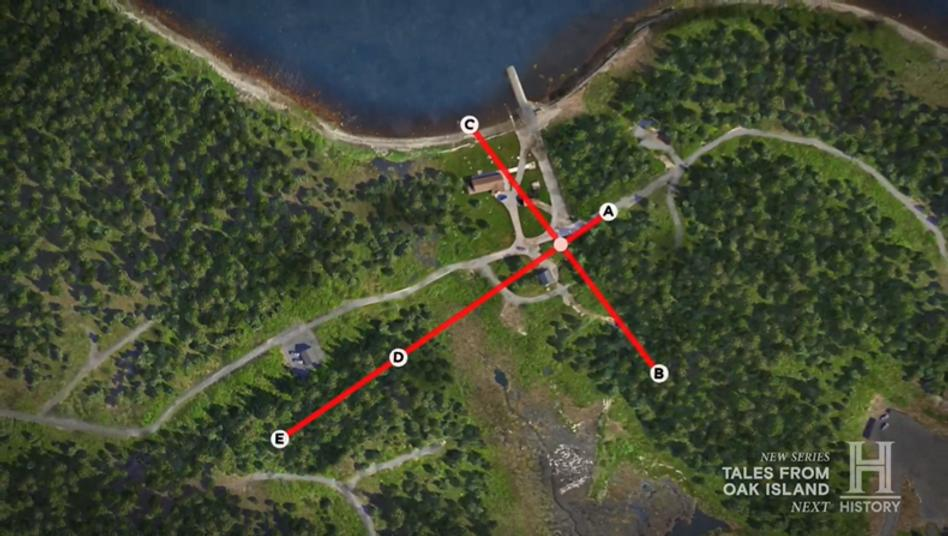
The research examines Nolan’s Cross alongside a geometric system reportedly appearing on the wall of a Templar church in France.
The connection is particularly intriguing because it introduces a possible historical framework for understanding the arrangement.
Rather than examining the stones as an isolated feature, this approach considers whether their positioning might follow geometric principles associated with an entirely different historical location.
That distinction matters.
If the patterns share meaningful structural similarities, Nolan’s Cross could potentially represent more than an unusual arrangement of stones.
But resemblance alone cannot establish historical contact.
The real challenge is determining whether the similarities are sufficiently precise to suggest a shared design rather than coincidence.
And that is where the eight potential locations become especially important.
EIGHT LOCATIONS AND THE KNIGHTS TEMPLAR CONNECTION
According to the Season 14 research update, comparing the geometric arrangement associated with Nolan’s Cross and the pattern from the French Templar church has generated eight potential positions for further investigation.
This is a significant development in terms of research direction.
Instead of relying exclusively on interpretations of the existing stones, investigators now have additional locations that could be examined against the proposed geometric model.
The importance of these eight positions lies not simply in their number, but in what they could help establish.
If the geometric comparison accurately reflects an intentional design, the positions might provide a framework for identifying relationships between different features of Oak Island.
They could also help researchers determine whether Nolan’s Cross was constructed according to a larger plan that has not yet been fully understood.
Naturally, this brings the Knights Templar theory back into the conversation.
For years, the possibility that the medieval religious and military order had some connection to Oak Island has attracted considerable interest among treasure hunters and historians.
The Templars’ historical activities, symbolism and association with European religious architecture have provided material for numerous theories about the island’s origins.
Some interpretations suggest that members of the order, or individuals connected to their historical network, could have been involved in transporting valuable objects across the Atlantic.
However, there is an important distinction between a historical possibility and documented evidence.
No confirmed archaeological finding establishes that the Knights Templar constructed Nolan’s Cross or deposited treasure on Oak Island.
The French church comparison does not independently prove such a connection either.
In fact, the most interesting aspect of this investigation may be the question it creates: how closely do the two geometric arrangements actually correspond?
A cross-like design is not automatically evidence of Templar involvement.
Geometric patterns can emerge independently in different places, particularly when researchers are examining structures with similar symbolic or architectural purposes.
To strengthen the theory, investigators would need to establish more than a general visual resemblance.
Measurements, proportions, orientation and the relationship between individual points would all need to support the proposed connection.
The eight potential locations therefore represent an opportunity to test the interpretation against the physical landscape.
If subsequent investigation identifies meaningful features at those positions, the comparison could gain additional historical significance.
If the locations fail to produce supporting evidence, the geometric theory would face a serious challenge.
Either outcome would help narrow the possibilities surrounding one of Oak Island’s most recognizable formations.
COULD NOLAN’S CROSS BE PART OF A MUCH LARGER PLAN?
The broader significance of this investigation extends beyond the eight potential locations.
For decades, much of the fascination surrounding Oak Island has focused on the Money Pit, underground structures and the possibility of a hidden treasure.
Yet Nolan’s Cross presents a different kind of mystery.
Rather than asking what might be buried beneath the ground, researchers are examining whether the landscape itself contains information about the people who may have visited the island centuries ago.
That possibility could change how other clues are interpreted.
If Nolan’s Cross was deliberately designed using a recognizable geometric system, its positioning might provide a new reference point for examining other historical features across the island.
Instead of treating each unusual structure or discovery as an isolated event, researchers could investigate whether several locations belong to a coordinated arrangement.
This would be particularly relevant to the Knights Templar theory.
A verified connection between the geometric design and a historically documented Templar structure would raise important questions about the origin of the knowledge behind the arrangement.
It could encourage further investigation into medieval architecture, navigation, symbolism and the possible movement of Europeans across the Atlantic.
But establishing that connection would require considerably more evidence.

Researchers would need to demonstrate that the similarities are specific enough to be meaningful, establish reliable measurements of the relevant features and determine whether the proposed eight positions correspond to physical evidence on Oak Island.
Chronology would be equally important.
Even if the geometric similarities were confirmed, investigators would still need evidence showing when Nolan’s Cross was created and who could have been responsible.
Without that information, the Templar connection remains an intriguing interpretation rather than an established historical conclusion.
Nevertheless, the Season 14 comparison gives the investigation a more focused direction.
The eight potential positions offer concrete targets against which the geometric theory can be examined, moving the discussion beyond speculation alone.
And perhaps the most compelling question is no longer simply whether Nolan’s Cross resembles a pattern found in France.
It is whether the eight locations can reveal something that has remained hidden in plain sight for generations.
If even one of those positions produces evidence consistent with the proposed design, could it provide the first meaningful step toward understanding who created Nolan’s Cross — and why?