Episode 3,
The Golden Ratio
, has given Oak Island fans several important developments to think about.
The search for gold deep beneath the Money Pit has taken another turn, while the investigation into the island’s mysterious structures and possible historical connections continues to raise questions.
But which details actually moved the investigation forward?
Could the latest drilling results point toward an undocumented underground structure?
And why does the title of this episode matter?
Here are the most compelling questions following the November 24 broadcast, along with what the available evidence can and cannot tell us.
THE MONEY PIT: DID THE TEAM FIND AN UNRECORDED TUNNEL?
Question 1: What was the most important development beneath the Money Pit?
The biggest development was the investigation of a suspected underground tunnel approximately 137 feet below the surface.
What makes this particularly interesting is that the structure does not appear in the historical records examined by the team.
Rick Lagina brought together surveyor Steve Guptill, historian Doug Crowell and Scott Barlow to investigate its possible origins.
Their research led them back to the plans of the Oak Island Treasure Company, including Shaft E, which was excavated during the 1890s in an attempt to reach the Chappell Vault.
The historical plans also documented a deeper flood tunnel approaching from the southern shore.
However, Doug could not find another recorded tunnel corresponding to the newly investigated location.
Question 2: Does this prove that the original Money Pit has finally been located?
Not yet.
But the possibility has become considerably more interesting.
The suspected tunnel lies less than five feet from the RP1 caisson.
Doug explained that if the structure represents original underground work rather than a later excavation, it could lead back toward the original Money Pit.
That distinction is crucial.
Finding an underground passage does not automatically establish who constructed it, when it was built or what purpose it served.
Steve proposed drilling another hole five to ten feet south to intersect the structure again and determine its direction.
This could provide information that a single borehole cannot deliver.
Question 3: Did the second drilling attempt confirm the tunnel?
It produced an important supporting observation.
The new borehole, located southeast of the earlier drilling position, reached the suspected tunnel depth.
When Terry Matheson, Steve and Peter Fornetti examined the core between 128 and 148 feet, they encountered similar slushy material.
This time, however, there was no wood.
Rick focused on how the clay layers were arranged, interpreting them as evidence that the space had once been open and that water had moved through it.
The result strengthens the case for investigating an underground opening, but it does not establish that the team has discovered a treasure chamber or a passage leading directly to buried valuables.
The next challenge is determining its direction.
If additional boreholes repeatedly intersect the same feature, the team could begin mapping its course rather than relying on isolated clues.
THE GOLDEN RATIO: ARE THE KNIGHTS TEMPLAR CONNECTIONS BECOMING MORE INTERESTING?
Question 4: Why is this episode called The Golden Ratio?
The title is connected to new historical research presented by Corjan Mol and researcher Chris Morford.
Their investigation examined a geometric pattern found in a Templar church at Montsaunès in southern France.
The church contains a painted grid of five by eight squares, with a three-by-three section marked in one corner.
Chris explained that the grid also appears at other Templar locations and corresponds with the geometry of the golden spiral.
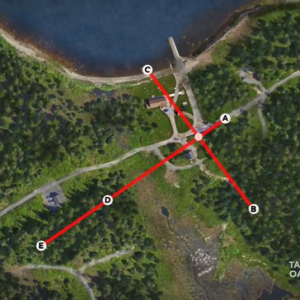
The researchers then applied this pattern to Nolan’s Cross on Oak Island.
According to their analysis, the arrangement fits the cross and creates potential locations for further investigation.
Question 5: How did this research produce eight new potential digging locations?
This was one of the most intriguing developments of the episode.
The golden spiral can be oriented in four different directions within the proposed grid.
Each orientation creates an endpoint, producing four potential locations.
Adding the four corners of the grid gives the team eight targets to investigate.
Marty was interested in having additional locations to explore, while Rick wanted to see whether the mathematical theory could be tested through actual excavation.
However, there is an important distinction: identifying geometric similarities does not establish that the Knights Templar created Nolan’s Cross.
The pattern provides a research direction, not historical proof.
Question 6: What happened when the team investigated the first geometric target?
The first location was selected on Lot 8, between the massive boulder and the area where Gary Drayton and Jack Begley discovered a copper token covered in symbols in 2022.
Before excavation began, Gary detected a square-shanked fastener and a curved iron strap resembling part of a barrel hoop.
Then Billy Gerhardt’s excavator bucket exposed something much more unusual: a pocket of blackened material approximately three feet below the surface.
Archaeologist Fiona Steele examined the material and identified it as rock that had been cracked and blackened by intense heat.
She considered it a possible indication of industrial activity and collected samples for laboratory analysis.
Rick raised another possibility: could this have been the remains of a signal fire used to establish or communicate the geometric layout?
That remains an interpretation, not an established explanation.
The material still needs to be dated.
Question 7: Does the burnt rock provide evidence of a Templar connection?
Not by itself.
The burnt material establishes a potentially important question about human activity at that location.
It does not identify the people responsible or prove that they belonged to a medieval religious order.
Its age is particularly important.
If laboratory testing places the material within a period consistent with the researchers’ historical theory, the discovery could become more significant.
If it dates to a much later period, the proposed connection would need to be reconsidered.
For now, the most valuable result is that the first geometric target has produced material worth investigating.
The remaining seven locations have not yet been established as discoveries.
THE DISCOVERY ON LOT 5: WAS THE TEAM LOOKING AT A WELL ALL ALONG?
Question 8: What was the mysterious stone structure on Lot 5?
One of the most satisfying answers came from an investigation that had been developing since the previous season.
Alex Lagina joined archaeologists Laird Niven and Fiona Steele to examine a stone structure near the shoreline.
Initially, it appeared to be a wall, with carefully arranged stones forming a more substantial base.
However, the structure was filled with water, making it difficult to determine its actual shape.
After Jack Begley and Craig Tester began removing the water, the arrangement of the stones became clearer.
The structure turned out not to be a conventional wall.
It was a round, stone-lined well extending underground.
This was a significant change in the interpretation of the site.
Instead of investigating an isolated wall, the team now has a possible water source or functional structure that could help explain how people used Lot 5.
Question 9: Could the well reveal how old the settlement on Lot 5 really is?
That is precisely what Rick and the archaeological team want to establish.
Rick noticed similarities between the newly identified well and another stone well on Lot 26.
In an earlier investigation, Dr.
Ian Spooner dated a twig recovered from the bottom of that well to between 1028 and 1172.
However, that date cannot automatically be transferred to the Lot 5 well.
The two structures may look similar, but their ages must be established independently.
Rick suggested collecting material from the bottom of the new well for radiocarbon dating.
Laird, meanwhile, emphasized the need to remove loose stones and stabilize the sides before anyone attempts further excavation inside.
Marty saw the discovery as another reason to consider whether Lot 5 served as an encampment associated with earlier activity on the island.
If dating evidence supports an early occupation, the well could become an important piece of the broader historical investigation.
Question 10: Did Episode 3 finally reveal the gold the team has been searching for?
No confirmed gold treasure was announced in the episode.
This is perhaps the most important distinction for viewers following the Money Pit investigation.
The drilling program was initiated because gold had previously been detected deep beneath the Money Pit area.
However, Episode 3 focused on understanding the suspected underground passage, the movement of water and the historical structures that might explain the island’s underground network.
The episode also revealed two square-shanked nails and a large iron staple along the LIDAR pathway between Lot 5 and the Lot 8 boulder.
Marty suggested that the staple may have been designed to secure a very large piece of timber, potentially connected to the boulder.
These objects offer additional clues about historical activity, but their precise purpose and relationship to the larger structures remain unresolved.
The episode therefore delivered something arguably more useful than another isolated metal signal: several new avenues for testing the history of Oak Island.