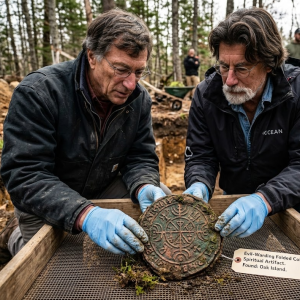
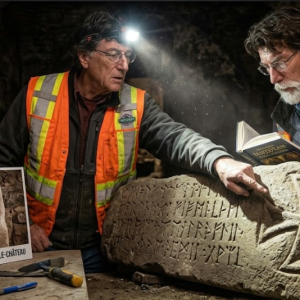
A new discovery on The Curse of Oak Island is once again pushing one of the island’s most enduring theories back into the spotlight, with renewed claims that the Knights Templar may have played a direct role in the construction of the legendary Money Pit.

For years, Oak Island has occupied a unique place in popular history. Located off the coast of Nova Scotia, the island has inspired generations of treasure hunters, historians and viewers who remain fascinated by the idea that something important, valuable or historically significant may still lie hidden underground.
Across decades of searching, the mystery has produced shafts, flood tunnels, old wood, metal fragments and a long list of unanswered questions. Now, according to the latest narrative surrounding the search, a newly analysed object recovered from the site is being presented as one of the strongest pieces of evidence yet in support of the Templar connection.
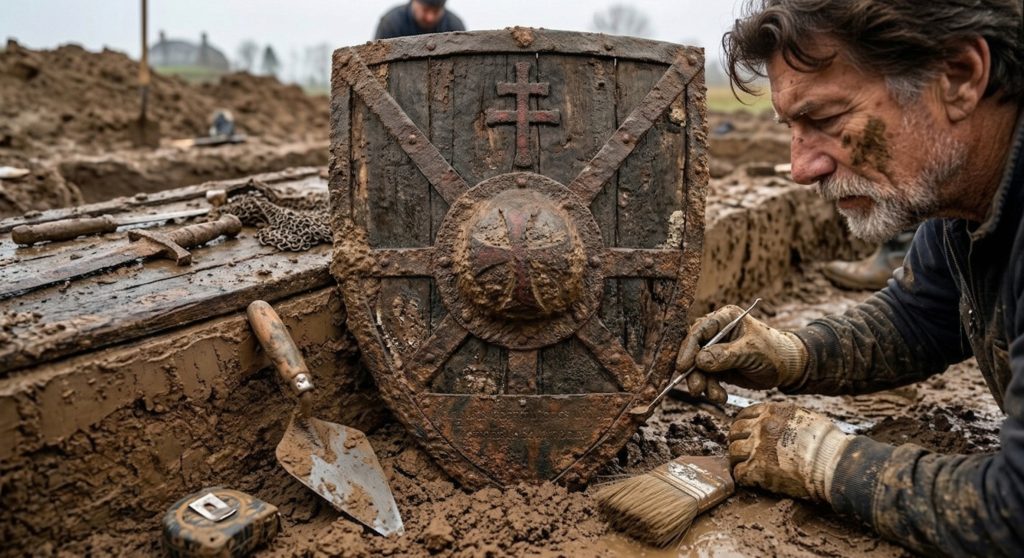
The item is described as dating to the late 13th or early 14th century and as showing characteristics consistent with medieval European metalwork. Its symbolism, according to the argument laid out around the find, is said to align with traditions associated with the Knights Templar.
That claim, if ever independently verified, would be highly significant. The Templars were a powerful medieval order founded in the early 12th century, originally tasked with protecting Christian pilgrims in the Holy Land.
Over time, they became wealthy, politically influential and deeply embedded in the financial and military systems of medieval Europe. Their dramatic downfall began in 1307, when King Philip IV of France moved against them, leading to arrests, confiscations and the eventual dissolution of the order. It is precisely that historical turning point that keeps fuelling speculation. One of the most persistent theories surrounding Oak Island suggests that, as pressure mounted in Europe, members of the order may have moved valuable material, records or religious objects beyond the reach of the French crown.
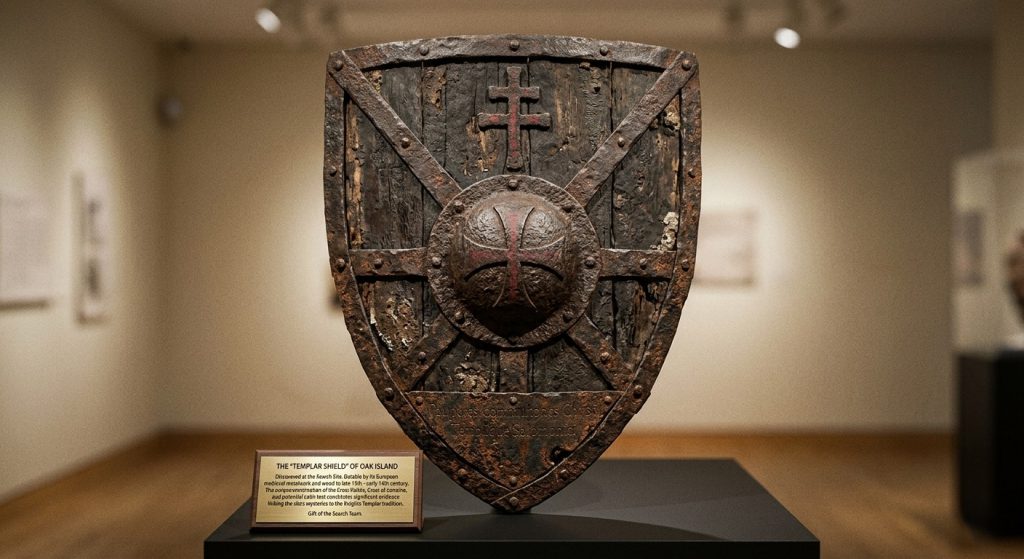
In this interpretation, Oak Island becomes more than a treasure site. It becomes a possible hiding place for an organised effort to preserve something of immense importance. Supporters of that theory often point to the complexity of the Money Pit itself. The traditional story of the site describes a shaft discovered in the late 18th century, reportedly marked by layers of timber at intervals underground.
Later searches added reports of engineered flood systems that made excavation exceptionally difficult. Within the Templar theory, these features are treated not as random anomalies, but as evidence of deliberate planning by an organisation with advanced knowledge of engineering, excavation and logistics.
The latest argument goes further by linking Oak Island not only to the Templars, but to medieval Scotland. According to this line of thinking, Scotland may have offered one of the few safer routes for Templar survival after the crackdown in France. That has helped keep alive the idea of a chain connecting the suppressed order, the Sinclair family and possible early Atlantic voyages to Nova Scotia long before Columbus. The newly analysed object is being framed as a missing piece in that broader historical pathway.
Still, the gap between compelling television and established history remains considerable. While the programme and its supporters may see the find as a major turning point, extraordinary claims require equally strong evidence. A single artefact, even if genuinely medieval, would not by itself prove that the Templars built the Money Pit or buried treasure there. It would, however, strengthen the case for a deeper medieval European presence connected to the island than many mainstream accounts have traditionally accepted.
That distinction matters. Oak Island has long thrived on the tension between evidence and interpretation. Each season brings new material that appears to point toward purposeful activity centuries ago, yet the full picture remains unresolved. What keeps audiences returning is not only the possibility of treasure, but the possibility that the island may hold evidence of a forgotten chapter of transatlantic history.
In that sense, the latest claim fits neatly into the wider Oak Island story. It offers a datable object, a recognisable historical framework and a dramatic conclusion: that the mystery may no longer be about whether the island was used for something important, but about who used it and why. Whether that conclusion stands up to wider scrutiny is another question entirely. For now, the discovery is likely to deepen interest rather than settle debate.
Those who already believe the Templar theory will see the latest analysis as vindication. Skeptics will continue to ask for independent confirmation, tighter provenance and stronger archaeological context. Both sides, however, can agree on one point: Oak Island remains remarkably effective at producing discoveries that reopen old arguments instead of closing them. And that may be why the mystery still holds such power.
Every new find seems to move the story forward, but never quite far enough to end it. On Oak Island, certainty remains elusive. But with each object pulled from the ground, the past becomes a little harder to ignore.