EMMA CULLIGAN UNCOVERS A NEW OAK ISLAND CLUE
The mystery surrounding Oak Island has taken another fascinating turn after archaeometallurgist Emma Culligan identified a possible connection between two iron objects recovered near the Lot 5 slipway and artifacts associated with Sir William Phips.
The discovery does not prove that Phips personally visited Oak Island or that he buried treasure there.
But the similarities are striking enough to give Rick and Marty Lagina another historical lead to investigate.
During Season 14, the team recovered a large hand-forged iron spike and a square-shanked iron nail from the shoreline area between Lots 4 and 5. What initially appeared to be ordinary pieces of old iron soon became considerably more interesting after Emma subjected them to detailed laboratory analysis.
TWO ORDINARY-LOOKING IRON OBJECTS
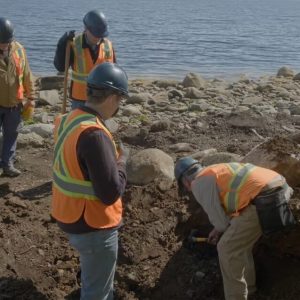
The first discovery came during excavation of a mysterious slipway on the border between Lots 4 and 5.
Metal-detecting expert Gary Drayton located a large iron spike buried deep in the sand. Archaeologist Laird Niven believed it could have been used as a cribbing spike in a wooden structure that had disappeared over time.
A square-shanked iron nail was subsequently recovered nearby.
Neither object looked spectacular.
There was no gold.
No silver.
No obvious treasure chest.
Yet their location immediately made them worth examining.
The team was already investigating evidence of human activity around Lot 5, including a stone feature and what appeared to be a possible historic structure.
The possibility that the iron objects belonged to that earlier activity meant their age and composition could provide important clues.
EMMA CULLIGAN TAKES A CLOSER LOOK
Rather than relying solely on appearance, the team brought the artifacts to Emma Culligan for scientific analysis.
Using CT scanning, Emma was able to examine the objects internally without destroying them.
She also used X-ray fluorescence, or XRF, to examine their metallic composition.
That distinction was important.
An old-looking piece of iron can come from many different periods.
Corrosion alone cannot establish exactly when or where an object was produced.
Its chemical composition, manufacturing characteristics and archaeological context can provide much stronger clues.
Emma’s examination found that the objects were hand-forged wrought iron and showed characteristics consistent with early-refined bloomery iron.
Her assessment placed the material broadly in the mid-1600s to mid-1700s.
That immediately made the discovery more interesting.
THE PHIPS CONNECTION
The most surprising part of Emma’s analysis came when she compared the iron with other historical samples.
According to the Season 14 discussion, the composition showed a particularly close similarity to iron artifacts associated with Sir William Phips.
Emma told the team that the objects matched Phips-related artifacts in her comparison.
The discovery immediately caught the attention of Rick and Marty.
Suddenly, two seemingly ordinary pieces of iron had become part of a much larger historical question.
Could people connected with Phips have been active on Oak Island?
Could the objects have been brought there during an earlier expedition?
Or could the similarity simply reflect the use of iron produced through comparable methods during the same period?
Those questions remain unanswered.
But the possibility is enough to send the investigation in a new direction.
WHO WAS SIR WILLIAM PHIPS?
Sir William Phips was not an obscure figure.
Born in what is now Maine in 1651, Phips began his career as a shipbuilder before becoming a sailor, treasure hunter and eventually one of the most prominent political figures in colonial North America.
His most famous achievement came in 1687, when his expedition located the wreck of the Spanish galleon Nuestra Señora de la Concepción.
The wreck had gone down in 1641 carrying a huge quantity of silver, gold and other valuables.
Phips and his crew recovered an enormous amount of treasure from the wreck, bringing him wealth and fame.
He was knighted by King James II in June 1687 and later became the first royal governor of the Province of Massachusetts Bay.
That history is particularly relevant to Oak Island because Phips was involved in treasure recovery during the same broad historical period suggested by Emma’s analysis.
THE CONCEPCIÓN THEORY
The connection becomes even more intriguing when the team’s existing Oak Island theories are considered.
Phips recovered a substantial amount of treasure from the Concepción, but the team has repeatedly discussed the possibility that not all of the recovered wealth was accounted for.
A long-running theory presented on The Curse of Oak Island suggests that Phips and people associated with him could potentially have moved treasure through the region.
The idea is controversial and remains unproven.
There is no established historical record showing that Phips secretly deposited treasure on Oak Island.
But the theory has persisted because Phips was known to have operated in the wider region and because his career was directly connected to the recovery of enormous quantities of precious metals.
The new iron analysis therefore gives the theory another piece of evidence to consider — although not definitive proof.
WHY THE IRON MATTERS
The importance of the discovery is not necessarily the value of the iron itself.
It is what the objects could reveal about human activity.
A hand-forged spike could have been part of a wooden structure.
A nail could have been used in construction.
If both objects came from the same period and share a distinctive metallurgical signature with known Phips-related artifacts, the team has a reason to investigate whether they are connected.
That could potentially help establish who was active on Oak Island before the famous 1795 discovery of the Money Pit.
The question is no longer simply:
What was buried on Oak Island?
It becomes:
Who was using Oak Island before the treasure hunt began?
LOT 5 BECOMES EVEN MORE IMPORTANT
The iron discoveries also increase the significance of Lot 5.
The area has already produced a collection of unusual archaeological evidence.
The team has identified a circular stone feature and other structures, while pottery and metal artifacts have helped establish that the area was active during the colonial period.
The new iron objects add another layer.
If they are connected to the same historical activity, Lot 5 could have been more than an ordinary settlement or work area.
It could have served a specific function that the team has not yet identified.
Marty has even suggested that the feature could have been a staging area for something much larger.
That interpretation remains speculative, but the combination of structures and artifacts gives the team plenty of reasons to continue investigating.
A CONNECTION, NOT A CONFIRMATION
There is one important point that should not be overlooked.
Emma’s analysis does not establish that Sir William Phips himself stood on Oak Island.
It does not prove that the iron was carried there by Phips.
And it certainly does not prove that Phips buried the legendary Oak Island treasure.
The scientific result is more limited.
The iron objects show compositional similarities to artifacts associated with Phips.
That makes a historical connection possible.
It does not make it certain.
Further archaeological context would be needed.
Researchers would need to establish exactly when the objects were deposited, whether they came from the same source and how they relate to the structures around them.
RICK LAGINA SEES A POSSIBLE LINK
For Rick Lagina, however, the discovery appears to be significant because it connects several separate pieces of the Oak Island puzzle.
Phips was involved in treasure recovery.
Phips operated in the region.
His artifacts provide a recognisable metallurgical comparison.
And now similar iron has been recovered from Oak Island.
That is enough for Rick to believe the possibility deserves serious attention.
But the team also knows that one clue is rarely enough to solve Oak Island.
The island has produced hundreds of objects that initially appeared extraordinary before ultimately raising more questions.
The challenge is finding several independent pieces of evidence that point toward the same conclusion.
THE MISSING TREASURE QUESTION
The Phips theory becomes particularly compelling because of the mystery surrounding the treasure recovered from the Concepción.
Historical records establish that Phips recovered a huge quantity of silver and other valuables from the wreck.
His success made him famous and wealthy.
But the Oak Island theory asks whether some portion of that treasure could have been diverted or hidden elsewhere.
There is currently no accepted historical evidence proving that happened on Oak Island.
Still, the possibility has become part of the wider investigation.
If future discoveries on the island produce more artifacts with the same unusual metallurgical signature, the theory could become increasingly difficult to dismiss.
If they do not, the current iron comparison may remain an intriguing coincidence.
WHAT COULD COME NEXT?
The biggest question is whether the team can find more evidence.
One pair of iron objects is interesting.
A larger collection of matching artifacts would be far more significant.
If additional material from Lot 5 or nearby areas shows the same characteristics, researchers could begin constructing a stronger picture of who was active there.
That could potentially help establish a timeline for the site’s use.
It could also explain why the area contains so many unusual structures and artifacts.
And if those findings eventually connect with discoveries in the Money Pit, the implications would become even greater.
OAK ISLAND’S HISTORY MAY BE GETTING CLEARER
For more than two centuries, Oak Island has been defined by theories.
Knights Templar.
Pirates.
Royal treasure.
Spanish gold.
British military activity.
Religious manuscripts.
And countless other possibilities have been suggested.
The challenge has always been separating an exciting theory from evidence capable of supporting it.
Emma Culligan’s analysis represents the kind of evidence the team needs.
It is measurable.
It can be compared with known historical materials.
And it gives researchers something concrete to investigate.
That does not solve the mystery.
But it narrows the possibilities.
A NEW NAME AT THE CENTRE OF THE MYSTERY
The name Sir William Phips now sits alongside the growing list of historical figures potentially connected to Oak Island.
Whether he actually played a role remains unknown.
But the discovery has given Rick and Marty something they have always needed: another testable historical hypothesis.
The two iron objects may ultimately prove to be ordinary colonial artifacts.
Or they could become part of a much bigger story.
For now, the evidence points only to a possible connection.
But on Oak Island, even a possibility can lead to another excavation, another laboratory test and another search for the missing piece.
And if Emma Culligan’s analysis is the beginning of a genuine Phips connection, these two forgotten pieces of iron could prove far more important than anyone expected…
The mystery of who was really on Oak Island centuries ago may have just gained a new suspect.