For years, the most unsettling stories told about Skinwalker Ranch seemed to rise out of the air. They appeared as lights no one could hold, radar returns no one could explain, sudden failures in equipment that had worked moments before, and reactions from experienced people who sounded less theatrical than unsettled. That was part of what made the place so difficult to pin down.
Almost everything about it seemed to happen at a distance or in fragments or in ways that left behind just enough testimony to be disturbing and just little enough proof to remain arguable.
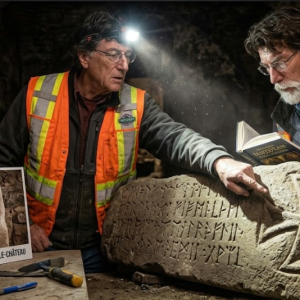
But in The Secret of Skinwalker Ranch season 6, episode 9, in the investigation centered on the tunnels and the energy radar scan, attention shifted in a direction that felt far more intimate. not upward but downward.
Not toward the sky but into the mesa.
And once that happened, the mystery changed.
Because a light in the sky can be dismissed as a trick of distance. A sensor anomaly can be filed away as interference. A story can be blamed on memory, fear, or folklore. But a tunnel is different. A tunnel has edges. A tunnel has direction. A tunnel suggests entry, concealment, interruption, and intent. Even when it forms naturally, it forces a simpler and more troubling question. If something is hidden beneath the ground, how long has it been there?
And who understood it before anyone else did? That was the deeper unease hanging over Brandon Fugal and the team as their work on the ranch drew them again and again toward the mesa. Skinwalker Ranch had never lacked for stories. For generations, the property had carried a reputation shaped by reports of strange lights, unusual animal behavior, odd sounds, missing time, equipment failures, and a kind of lingering discomfort that many visitors found
difficult to describe without sounding embarrassed by their own words. That history created a problem as well as an atmosphere. The more legends gathered around the ranch, the easier it became for critics to dismiss everything that followed. Story has a way of weakening evidence, even when evidence exists. And on this ranch, evidence had always seemed to come in fragments.
That is one reason Brandon Fugal mattered to the investigation.
He did not arrive as a campfire storyteller or a man looking to be frightened for entertainment. He arrived as a businessman, a property owner, and a public figure who understood exactly how costly extraordinary claims could be if they collapsed under scrutiny. His interest in the ranch was often framed in public as curiosity, but curiosity by itself does not explain the persistence.
What held him there was the possibility that beneath the folklore there might be a pattern, not a legend, not a ghost story polished over decades. a pattern, something measurable, repeatable, perhaps still incomplete, but real enough to justify serious attention.
That seriousness had already shaped the rhythm of the ranch. Over time, the investigation had come to include scientists, engineers, ranch staff, instrument specialists, camera systems, controlled tests, flights, drilling, scans, and long hours devoted to events that often refuse to behave consistently enough to satisfy anyone. Again and again, the team confronted the same frustration. Witnesses described something unusual.
Instruments hinted at something unusual.
But the moment anyone tried to reduce the event to a simple explanation, the details began to scatter. Some phenomena seemed airborne. Some seemed localized.
Some seemed tied to specific places. And one place, more than any other, kept pulling them back. The mesa did not announce itself in a dramatic way. At first glance, it was simply part of the landscape, a massive formation overlooking the ranch, like something ancient and indifferent. But over time, the mesa stopped feeling like scenery.
It became a point of recurrence. Reports clustered around it. Observations drifted back toward it. Technical work conducted near it produced questions that did not entirely belong to the open desert. The more the team studied the ranch, the more the mesa seemed less like a backdrop than a participant.
That shift matters because once a mystery begins to cluster around a single place, the question changes. It is no longer only what is happening here. It becomes what is inside this place, beneath it or behind it? And that is a far more physical question. A light over a field can vanish. A tunnel beneath a mesa can remain. By the time the investigation turned more directly toward what might exist within the mesa, the team had already accumulated enough strange moments to approach the task with caution. There were archival photographs that seemed to suggest changes in the terrain. There were old hints that the area had drawn attention long before the present investigation.
There were drill efforts that produced obstructions, fragments, and readings that did not sit comfortably inside a purely ordinary explanation.
Even before anyone could say with confidence what was hidden there, the working assumption had begun to change.
The mesa was no longer merely a place where odd things happened nearby. It was starting to look like the place where at least some of those odd things might begin.
That possibility brought its own tension. Geological anomalies exist.
Rock collapses, voids, mineral concentrations, buried debris, old disturbances, and natural cavities can all produce confusion. The existence of a tunnel alone proves very little. But ambiguity has a way of increasing suspense when the setting already carries a history of unresolved events.
Was the space natural? Was it collapsed?
Was it modified? Had it been entered before? Was it ancient, recent, misunderstood, or part of some larger structure no one had yet mapped? The important thing was not that the team had immediate answers. The important thing was that they had reached a point where ignoring the underground possibility no longer felt responsible.
For Brandon Fugal, that appears to have been one of the key psychological turns in the entire investigation.
It is one thing to sponsor experiments aimed at strange lights, unexplained signals, or fleeting anomalies over open land. It is another to face the possibility that the ranch may contain a hidden physical layer that has been influencing everything above it. Aerial mysteries can remain abstract.
Underground mysteries feel permanent.
That is why the decision to go inside carried more weight than a routine field procedure. Once you enter a hidden space, you step away from speculation and into contact. The question stops being whether a place might matter and becomes whether you are prepared for what that place will show you. And on a ranch where even surface level work had produced unease, that threshold mattered. The practical realities alone were enough to slow anyone down.
Confined spaces are never casual. They change sound. They change movement. They change judgment. They introduce concerns about footing, stability, visibility, air quality, communication, and exit.
Even in an ordinary setting, a tunnel narrows the mind. Every scrape matters more. Every silence becomes noticeable.
Every instrument reading seems heavier because the space around it feels more personal. So when the team prepared to explore what lay beneath or within the mesa, the atmosphere was not one of swagger. It was controlled, careful, and visibly alert. Different personalities met the moment in different ways. Some approached it with the discipline of problem solvers, determined to document before interpreting. Some carried skepticism, which in a place like this is not a weakness, but a necessary guard rail. Others seem to feel the pressure more instinctively, not because they were prepared to declare anything paranormal, but because entering a hidden corridor on Skinw Walker Ranch is psychologically different from setting up a camera in an open field. Out in the open, distance offers comfort.
Underground, distance disappears.
That may be the most important emotional turn in the entire story. Skinwalker Ranch had long been associated with vastness, open sky, wide land, distant lights, and events that seem to hover just beyond reach. But a tunnel reverses all of that. It compresses the experience. It brings the unknown within arms length. It takes a mystery once spread across acres and folds it into stone, darkness, and walls close enough to touch. The moment of entry then becomes more significant than it might appear from the outside. Before any discovery is made, before any interpretation is proposed, there is a simple but powerful crossing. Behind them lies open country, familiar horizon, usable distance. Ahead lies enclosure, limited light, uneven ground, a space where the next few feet matter more than the next few miles. That is the moment when the ranch stops feeling immense and starts feeling close. And almost immediately, the tunnel seems to exert its own influence. Long before anyone can point to a final conclusion, the environment itself begins to do narrative work. Darkness in a confined place is never just darkness. It has texture. It absorbs depth. It changes the speed of thought. A wall is not only a wall when you do not yet trust its shape. A silence is not only a silence when everyone inside it is waiting for one detail that does not fit. What people notice first in such places is often not a spectacular object but a series of small dissonances.
The space feels wrong before anyone is ready to explain why. That feeling deserves attention, especially in a serious investigation.
Because human reaction often reveals the presence of uncertainty before language catches up. A pause that lasts too long, a change in tone, a glance exchanged without comment, a sentence started and then revised. These moments are not proof of anything supernatural, but they are signs that expectation and reality are no longer aligned. People enter a space assuming it will behave one way, then it behaves another. Inside the tunnel, the details begin to accumulate in exactly that manner. Texture matters.
The arrangement of rock matters. Signs of blockage matter. Hints of interruption or alteration matter. The geometry of a space can matter, especially when it feels inconsistent with what those present expected to find. No single feature needs to be extraordinary on its own for the overall impression to become significant.
Suspense grows when each ordinary explanation remains possible. Yet none of them seems quite sufficient to account for the full pattern. This is where Brandon Fugal’s presence becomes especially useful to the story. He is not compelling because he is expressive in a theatrical sense. He is compelling because the audience can watch his degree of certainty change in real time.
When a composed person recalibrates, the recalibration itself becomes evidence of pressure. He does not need to announce a revelation for viewers to understand that something inside that space is forcing a reconsideration.
And that reconsideration appears to deepen as the team compares what they expected with what they are actually encountering. Earlier work around the mesa had already produced enough odd results to justify concern. There had been drilling operations into the mesa and bore holes that behaved in frustrating ways. There was a camera sent into borehole 2 that should have provided visibility. Yet the recorded view remained pitch black as if the lights themselves were being swallowed rather than reflected. That alone would have been strange enough to remember.
Instead of a clear interior view, what emerged were tiny flashing specks raising the possibility that even the simplest act of looking into the mesa would not behave as expected.
There were also practical complications that on an ordinary site might be dismissed as mechanical inconvenience, but on this ranch accumulated a more pointed meaning. Equipment snagged. A drill head encountered obstruction. Side teeth on a new bit came back chewed down. PVC casing met resistance.
Progress was repeatedly interrupted by something in the mesa that refused to yield in a clean and predictable way.
Again, no one piece of this proves a grand hidden secret. But taken together, such events create a mood far more serious than mere inconvenience.
They suggest a place that does not easily give up its interior. Then came measurements that made the underground question even harder to wave aside.
Ground penetrating radar work and related instrument passes pointed towards something with physical thickness inside the mesa. At roughly the same area where the team identified a disturbance in the Earth’s magnetic field, the radar data suggested an object or feature of notable depth around 6 ft thick near the 270 ft mark.
At another point, a handheld spectrum analyzer registered a 1.6 ghahertz signal. These readings did not amount to a final explanation, but they did something perhaps more important. They established that the team was no longer dealing only with atmosphere, reputation, or personal testimony. They were dealing with layered anomalies that seemed to overlap in one physical region.
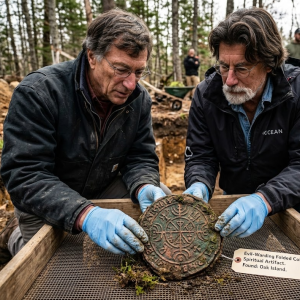
That is the context in which the tunnel discovery becomes so powerful. Brandon Fugal is not reacting to a single spooky moment. He is reacting to convergence, a hidden or partially hidden underground route, repeated resistance inside the mesa, darkness where visibility should have existed, magnetic disturbance, radar indication, the possibility of a significant internal feature, ceramic material recovered from the mesa that later testing would show contained elements including titanium, calcium, iron, aluminum, and venadium. None of these facts settles the question. But together they begin to suggest that the mystery is not scattered randomly across the ranch. It may have architecture. And once a mystery seems to have architecture, everything changes. The core of the discovery is not merely that Brandon Fugal saw something underground.
It is that what he saw appeared to shift the entire conversation away from the old debate between believers and skeptics and toward a more difficult and useful question. What kind of physical reality could generate this pattern?
hidden in access, a collapsed chamber, an altered geological space, evidence of prior disturbance, a buried structure, a natural formation whose significance has been misunderstood.
The point is not which answer wins immediately. The point is that the discovery demands the question be asked in earnest. That is why underground revelations carry a different emotional weight. A strange light can feel transient. A tunnel feels historical. It suggests duration. It suggests that whatever matters here did not begin when the cameras arrived and will not end when they leave. The underground has a way of implying memory. Even an empty hidden space feels like evidence that time has been accumulating around a secret. Skeptics quite reasonably can object at every stage. They can argue that instrumentation can mislead, that rock formations can confuse interpretation, that production framing can heighten tension, that a tunnel is not the same as proof of anything extraordinary.
All of that is fair. Mature suspense does not require those objections to vanish. In fact, the objections strengthen the story when the story is handled honestly. The more carefully ordinary explanations are considered, the more revealing it becomes when the remaining uncertainty refuses to disappear.
And in Brandon Fugal’s case, the change seems less like a surrender to wild belief than a hardening of concern. The underground question was no longer speculative decoration around the edges of a paranormal television series. It had become central. If there was something substantial beneath the mesa, then the team was not just investigating scattered incidents on a ranch. They were investigating the possibility that the ranch’s surface phenomena were expressions of something anchored below.
That is where the instruments matter again. The team did not respond to the tunnel with wonder alone. They tried to evaluate. They compared readings. They pushed equipment. They examined materials. They reviewed visual impressions against technical data. They continued the slow, often unglamorous process of asking whether what they had found could be explained away through known geology, common interference, or understandable error. But the effort to explain it away encountered its own problem. The evidence may have been incomplete, yet it did not behave like a simple mistake. A camera with lights could not illuminate a bore hole in the expected way. Magnetic data suggested disturbance. Radar suggested a thick internal feature. Drill operations encountered resistance in locations that continued to matter. Ceramic material from within the mesa showed a composition that kept attention fixed on what had been recovered, especially given the presence of venadium, an element associated in some contexts with advanced metallurgy and aerospace applications.
Even the behavior of one shard under extreme cold bubbling longer than expected in liquid nitrogen added another layer of unease. Not because it proved a sensational theory, but because it kept preventing closure.
This is the point at which a responsible investigation becomes psychologically difficult. Complete proof is absent.
Complete dismissal feels premature.
People respond differently under that pressure. Some lean harder into conventional explanation because the alternative opens too many doors at once. Others begin to consider that the overlapping anomalies may not be separate at all. the tunnel, the buried readings, the recovered material, the repeated resistance, the signals, the strange visual failures, the patterns around the mesa, the aerial phenomena above the ranch. Perhaps these are not isolated curiosities, but symptoms of the same underlying condition.
If that is even partly true, then Skinwalker Ranch must be understood differently. It is no longer simply a place where odd things appear in the sky or where witnesses come away with stories they struggle to defend. It becomes a layered environment.
Surface events above, hidden structure below, and between them some unresolved relationship that may be geological, technological, historical or something not yet named with confidence. That layered idea changes the emotional register of the ranch as well. Sky anomalies inspire awe because they are distant. Underground anomalies inspire dread because they are near. A light over a field can vanish back into night. A tunnel inside a mesa suggests that the unknown is not passing through. It may be staying put. For older viewers especially, that distinction carries weight. Spectacle fades quickly. What lingers is the sober realization that patient observation can still uncover something the modern world had assumed would either be trivial or already understood. There is a particular unease in watching competent adults, many of them careful and measured by nature, realize that a place they thought they were investigating from the outside may need to be understood from within. And once that thought takes hold, new questions arrive almost automatically.
If the tunnel is only one accessible fragment, how much of the internal landscape remains unseen? If there is a significant feature within the mesa, what lies beyond the reach of the current bore holes, behind collapses, past unstable sections, or deeper in rock that resists entry? If materials recovered from the mesa continue to raise questions, what remains embedded where no one has yet looked? And if the ranch’s most famous mysteries above ground are connected to what lies below, then how much of the story has been misread because investigators began with the sky instead of the stone? These are not rhetorical questions in the cheap sense. They are the kind of questions that emerge when a working theory begins to fail. Before the tunnel, Skinwalker Ranch could still be imagined as a site of scattered anomalies, a place where unusual events happened with no obvious center. After the tunnel and after the data that clustered around the mesa that becomes harder to maintain, the mystery may still be unresolved, but it no longer feels centerless. And that perhaps is what changed everything for Brandon Fugal. Not certainty, not final proof, not a theatrical unveiling of the impossible. What changed everything was the sense that the ranch had become more concrete. The unknown had acquired location. It had edges now, depth, resistance, material. The old discomfort of Skinwalker Ranch had always come from the thought that something strange might be present. The new discomfort comes from the possibility that something substantial may be present in a strange way that is more disturbing than any flying light. The human mind is better at setting aside distant mysteries than hidden physical ones. People can live with the idea that they may never explain every light in the sky. It is harder to live with the idea that a buried corridor, a concealed chamber, or a resistant internal feature may sit beneath familiar ground, altering events above it while remaining only partly accessible. The more physical the mystery becomes, the harder it is to reduce to folklore.
And yet, the most disciplined response is still restraint. No honest narrator can say the tunnel solved Skinwalker Ranch. It did not. It may not even represent the final center of what happens there. Perhaps the underground anomalies will eventually prove geological.
Perhaps the materials will find an ordinary chain of origin. Perhaps the pattern will narrow into something far less exotic than the ranch’s reputation suggests. Those possibilities remain open and they should remain open. But intellectual honesty cuts both ways. If caution requires resisting exaggerated conclusions, it also requires resisting easy dismissal. The underground findings around the mesa did not end the debate.
They made the debate more serious. They forced a shift from broad speculation towards specific physical questions.
They made it harder to say that the mystery survives only because no one has managed to touch it because now in some form they have touched it. They have drilled into it. They have sent cameras toward it. They have measured around it.
They have recovered material from it.
They have watched instruments behave oddly in relation to it. And in the midst of all that, Brandon Fugal appears to have recognized that the ranch was no longer just a location where unexplained things were reported. It was becoming a place with internal structure, a place that might conceal the very thing generating the questions that had drawn people there for generations.
That realization leaves the story in a more unsettling place than where it began. At the beginning, the mystery of Skinwalker Ranch belonged largely to atmosphere, testimony, and scattered phenomena. By this stage, the mystery feels quieter, heavier, and less dismissible. It is no longer only the mystery of what witnesses saw. It is the mystery of what may be physically embedded beneath the land. And that is why the tunnel matters even if it explains nothing completely. It changes the shape of the unknown. It narrows the field. It introduces the possibility that the ranch’s history is not simply a collection of eerie events, but a response to something rooted, hidden, and enduring. A sky mystery invites wonder. A buried mystery invites return.
In the end, the most disturbing discoveries are often not the loudest ones. They do not arrive with spectacle.
They arrive as an obstruction that should not be there. A darkness that does not behave as expected. A reading that aligns too closely with another reading. A fragment that keeps raising the wrong kind of question. or the quiet expression on the face of a careful man who realizes his original theory may no longer be big enough. So the underground tunnel beneath Skinwalker Ranch does not close the case. It does something more lasting than that. It leaves behind a harder question than the ranch had before. Not whether the mystery is real in the abstract, but whether something beneath that messa has been shaping the story all along. And if that is true, then the strangest secret on a property famous for what appears in the sky may have been waiting patiently and almost silently in the dark below the ground.
And perhaps that is the image that lingers longest after the episode ends.
Not a flash in the sky, not a dramatic declaration, not even a single instrument reading frozen on a screen, but the simple idea of grown men standing at the mouth of a hidden place, realizing that the ranch may be older in its mystery than they first imagined. A place can feel haunted by story. It can feel burdened by reputation. But when Stone begins to suggest design, obstruction, memory, and depth, the feeling changes. It becomes less like rumor and more like evidence, waiting for the right question. Brandon Fugal did not walk away from that tunnel with every answer. He walked away with something more consequential than that.
He walked away with reason to believe that Skinwalker Ranch may not be hiding a spectacle. It may be hiding a structure. And structures, unlike stories, remain in the dark until someone finally learns how to enter them.