The 225-year-old mystery of Oak Island has just glittered with its most glamorous, and potentially most significant, discovery yet. In a season already defined by the recovery of 14th-century Roman coins and the unearthing of an ancient stone tomb, the “Fellowship of the Dig,” led by Rick and Marty Lagina, has officially confirmed the find of a stunning, intact jeweled brooch dating back to the 1500s.
Located deep within the specific clay layers of the “Baby Blob” area—just meters from where previous high-trace gold signals were detected—the artifact is not merely a piece of jewelry. It is a chronological marker that places a incredibly wealthy, and likely European, presence on the island centuries before the official discovery of the Money Pit in 1795.
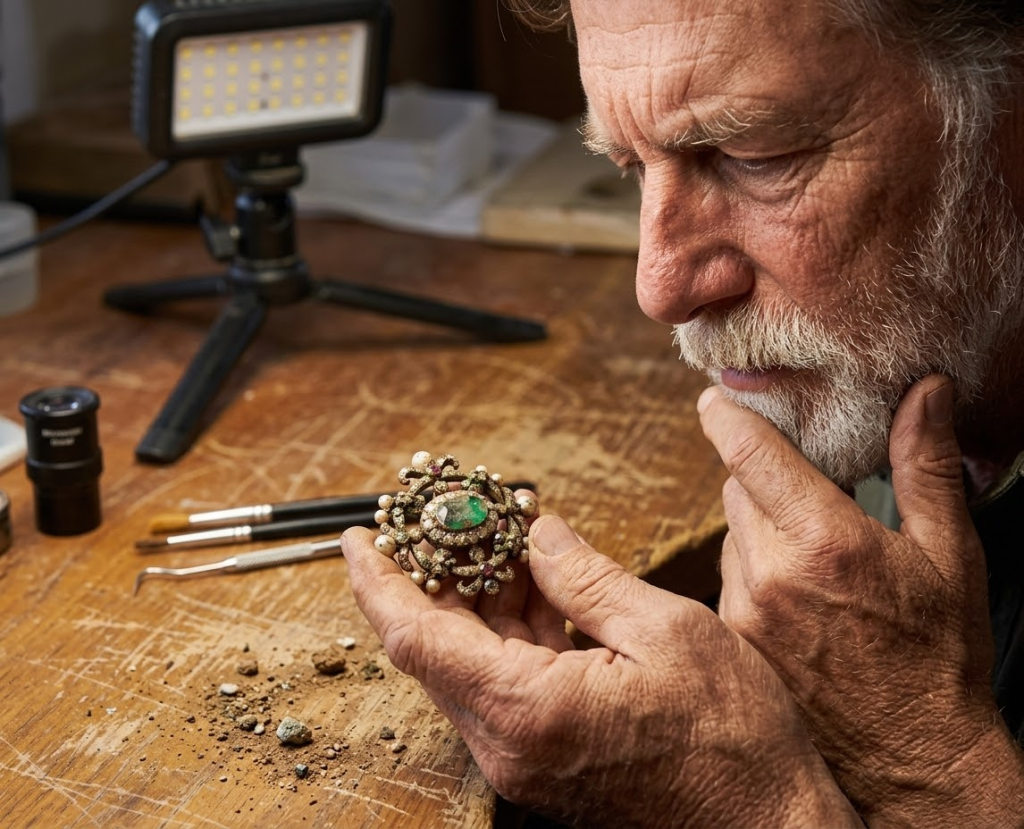
A “Top-Pocket” Find of a Lifetime
The discovery occurred during a routine metal detection sweep by the team’s resident expert, Gary Drayton. The Minelab detector, which has previously found 17th-century Spanish “maravedis” and Templar-cross-shaped lead, emitted a deep, solid tone.
“I thought I’d struck a brass button at first,” Gary Drayton remarked, still visibly emotional in the War Room. “But as I brushed away the blue clay, it just started to shine. When I saw the facet on the main stone, I knew this wasn’t from a simple colonial settler. This is a jeweled brooch, mates. It’s the real deal.”
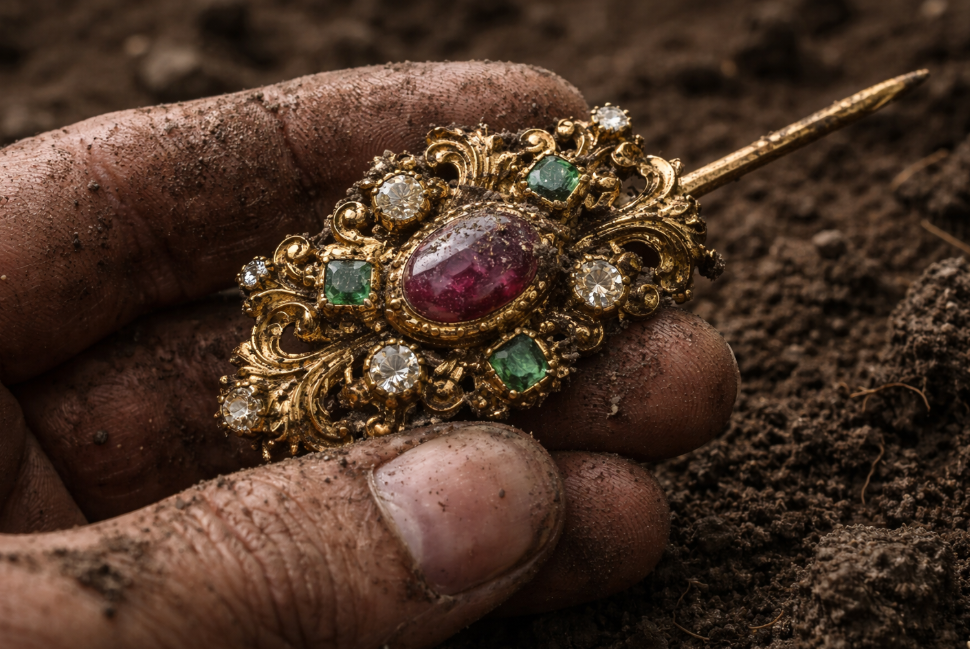
A Masterpiece of Renaissance Jewelry
The brooch, currently under heavy guard following the theft of the Roman coins earlier this season, features a complex design indicative of High Renaissance craftsmanship.
- The Stones: The main setting appears to be a large, cushion-cut, deep-red stone, likely a ruby or a high-grade garnet, surrounded by several smaller, brilliantly clear stones—potentially diamonds or sapphires.
- The Metalwork: The stones are set in what metallurgical scans suggest is high-purity gold or silver gilt, utilizing an intricate “filigree” technique common in European courts of the 16th century.
- The Style: The symmetric, “rosette” pattern closely resembles designs favored in the royal courts of England, France, and Spain during the 1500s.
Evidence of Royalty or Templars?

The 1500s was a period of tumultuous world history—from the height of Spanish conquest in the Americas to the height of the religious wars in Europe. The presence of such a high-status item on a remote island raises two explosive theories for the team:
- The Royal Cache Theory: During the 16th century, countless royal treasures were lost at sea or hidden. Could this brooch be part of the Lost Jewels of Mary, Queen of Scots, or perhaps part of the vast Spanish Treachery hoard? Its discovery near the newly unearthed U-shaped structure at Smith’s Cove suggests it was part of a major, deliberate operation.
- The Templar Link: While the Knights Templar were officially dissolved in the 14th century, many believe they continued in secrecy. If the brooch dates back to the Templar connection suggested by the recently discovered 14th-century coins and tomb, it would prove that a powerful, wealthy organization was active on the island across several centuries, hiding multiple caches.
“This is the ‘smoking gun’ that this wasn’t just a place to hide a chest of pirate gold,” Rick Lagina said, staring at the high-resolution photos. “This is evidence of a royal mandate. This is the jewel that proves the legend.”

Validating the Find
Following the recent security breaches and the physical struggles of Alex Lagina, the team is taking no chances. The return of archaeologist Miriam Amirault has provided the team with the scientific expertise needed to validate the find.
Miriam has initiated a full stratigraphic profile of the discovery site to carbon-date the surrounding organic material. If the soil dates to the mid-1500s, it will confirm the brooch was lost or buried during that exact era, finally silencing the skeptics and setting the stage for the most explosive Season 13 finale in the show’s history.
“We are looking at the ‘bones’ of a kingdom,” Gary Drayton concluded. “And this is the eye of the king.”